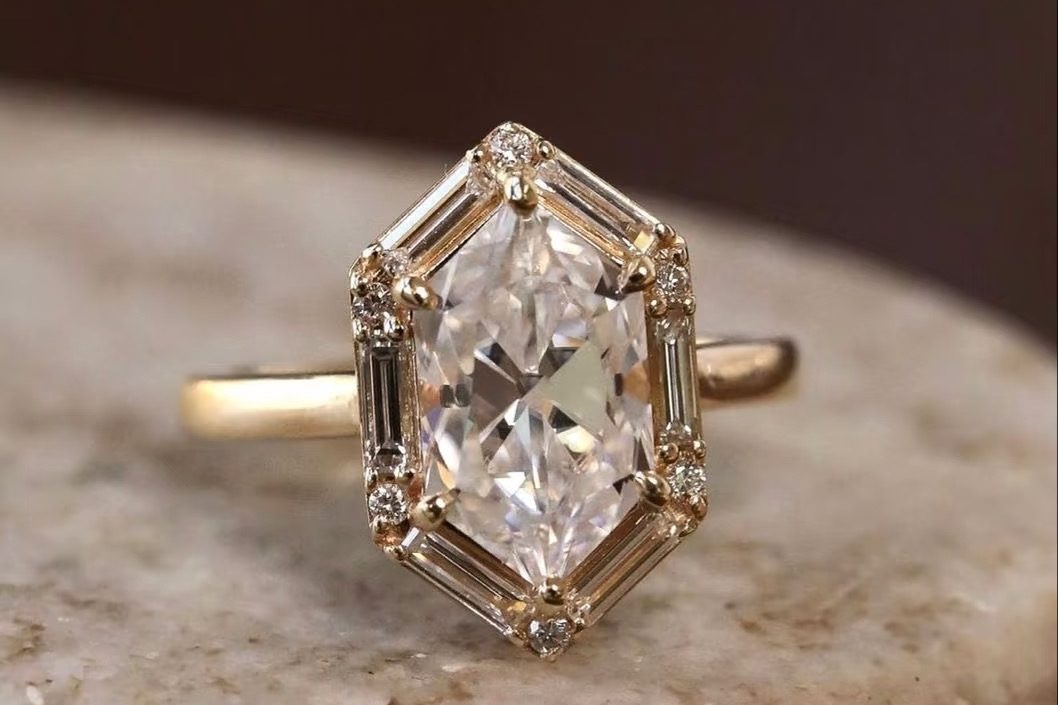
There is a specific kind of buyer who walks into an estate case and immediately understands why the stones look different. The light comes off an old cut in broad, slow flashes rather than sharp pinpoints, the metalwork has a softness that casting cannot reproduce, and the ring does not look like every other ring in the mall. That buyer is usually right about what they are seeing and often wrong about what they are buying.
This guide is about the second part. Vintage and estate engagement rings are genuinely good value, genuinely better made in some eras than anything produced now, and genuinely full of traps. The traps are not mysterious; they are just not visible from the top of the case.
A note on prices
All prices are street prices observed in 2026 across US and EU dealers, auction houses and estate jewelers. Estate prices vary far more than new prices because condition varies, so treat every figure as a range and get any significant piece appraised independently before you pay.
What "vintage" and "estate" actually mean
The trade uses both words loosely, and it is worth being precise because it affects price.
Vintage means made at least twenty years ago, and usually implies a recognisable period style. Antique conventionally means over one hundred years old. Estate is a legal and commercial term, not an aesthetic one: it means the piece has been previously owned, regardless of age. A 2019 ring sold second-hand is an estate ring. An 1890s ring sold by the original family is also an estate ring, and the two have nothing else in common.
The distinction matters because estate pricing is driven by condition and provenance, while vintage pricing is driven by period and style. A perfect 1950s ring and a battered 1950s ring are both vintage; only one is worth the asking price.
The old cuts, and how they behave
Before the modern round brilliant was standardised in the 1920s and refined through the 1980s, diamond cutting was an empirical craft. Cutters worked to maximise weight from the rough and to produce the best effect under candlelight, which is a very different optimisation target from "maximum light return under diffuse daylight." The result is a family of cuts that are not inferior versions of a modern brilliant. They are answers to a different question.
Old mine cut (roughly 1700–1890)
An old mine cut has a cushion or irregular outline, a small table, a very high crown, a deep pavilion and a large open culet — the flat facet at the bottom of the stone that shows as a dark dot from above. Proportions vary enormously because each stone was cut by hand to suit the rough.
The visual signature is softness. Old mine cuts have broad, chunky facets that flash rather than sparkle, and the large culet reads as a visible point of darkness in the centre. In candlelight, which is what they were designed for, they look remarkable. In a modern showroom's high, diffuse lighting, they can look sleepy to someone who has been trained by modern brilliants.
Old European cut (roughly 1890–1930)
An old European cut is the bridge: round rather than cushion, with a larger table, a lower crown, a smaller culet and a more regular facet arrangement. It is still visibly different from a modern round brilliant — a typical old European has a table around 45 to 53 percent of its diameter against 55 to 58 percent for a modern stone, a crown height around 15 to 20 percent against 14 to 16 percent, and a much deeper pavilion.
That deeper pavilion is the key commercial fact. An old European cut concentrates more of its weight below the girdle, so a 1.00-carat old European looks noticeably smaller from above than a 1.00-carat modern round brilliant. The difference in spread is typically 5 to 10 percent of diameter, which is roughly the visual difference between a 1.00 and a 0.90 carat modern stone. You are paying for weight you cannot see.
Transitional cut (roughly 1930–1950)
The transitional cut is the missing link: a round stone with a larger table and a lower crown than an old European, but without the precisely engineered pavilion angles of a modern brilliant. Transitional cuts are the most variable category, because they span the decades in which cutting was being systematically re-engineered.
A good transitional cut is close to a modern brilliant in performance and much cheaper. This is the sleeper category in estate buying, and the one we most often recommend to people who want an old stone's character without a large optical compromise.
Single cut (small stones, all eras)
Single cuts have eight facets on the crown rather than the thirty-three of a full brilliant. They were used for small accent stones throughout the Victorian and Edwardian periods and are still made today for inexpensive melee. They produce a softer, less brilliant effect, which is exactly right in a period mounting and slightly wrong in a modern one. If you are matching a missing accent stone in an antique ring, a modern full-cut melee will look out of place; a single cut or a rose cut will match.
| Cut |
Period |
Outline |
Table |
Crown |
Culet |
Character |
| Old mine |
1700–1890 |
Cushion, irregular |
~40–48% |
Very high |
Large |
Broad, soft flashes |
| Old European |
1890–1930 |
Round |
~45–53% |
High |
Medium |
Warm, chunky sparkle |
| Transitional |
1930–1950 |
Round |
~53–57% |
Medium |
Small |
Close to modern |
| Modern round brilliant |
1950–present |
Round |
55–58% |
Medium |
Pointed or none |
Sharp pinpoint sparkle |
| Single cut |
All eras |
Round |
Small |
Low |
Varies |
Soft, muted |
Why an old cut can be cheaper per carat and still more beautiful
The modern diamond market prices cut against a single benchmark: light return as measured on a modern round brilliant. An old European cut scores poorly on that benchmark by design. It leaks light through a deep pavilion and a large culet, and it does not produce the sharp contrast pattern the market rewards.
So the market discounts it. A 1.00-carat old European cut, G colour, VS2, might trade at $3,800 to $5,200 in 2026 where an equivalent modern round brilliant trades at $5,500 to $7,500. That is a 15 to 35 percent discount for a stone that, in the right mounting and the right light, looks better to many people than the modern one.
Whether that is a bargain depends entirely on what you want. If you want maximum sparkle under office lighting, it is not a bargain; it is a compromise. If you want a stone that looks like nothing else and you are buying a ring, not an investment, it is the best value in the diamond market.
The eras, and what each one means for you
Victorian (roughly 1837–1901)
Victorian rings are heavy, warm and handmade. Typical features include carved or repoussé shoulders, black enamel mourning details in the earlier decades, and clusters of old mine cut diamonds or coloured stones set in high-crown mountings. Yellow gold dominates, with silver-topped gold common in the mid-period for white-looking settings.
What to know: Victorian rings are the most likely to have structural problems, because they are the oldest and because yellow gold of that era was often 9K or 15K rather than 14K or 18K. Check the shank thickness carefully. Restoration is possible but must go to a jeweler who works with period pieces, and not every bench does.
Price range: $1,800 to $9,000 for a genuine Victorian diamond ring, with the top of the range reserved for large old mine stones with original mountings.
Edwardian (roughly 1901–1915)
Edwardian rings are the lightest and most technically virtuosic ever made. Platinum became workable at the bench in this period, and makers pierced, engraved and millgrained it to a degree that modern manufacturing does not attempt because it would not survive a retail environment. A good Edwardian ring weighs under two grams and looks like lace.
What to know: This is the era where "where it fails" applies most directly. Edwardian filigree is not a daily-wear ring. The metal is thin by design, the settings hold stones with very little material, and a modern hand doing modern things will damage it. Buy it to wear carefully, and insure it.
Price range: $2,500 to $14,000. Original Edwardian pieces with large stones are scarce and priced accordingly.
Art Deco (roughly 1920–1935)
Art Deco is the most commercially popular estate category and the most reproduced. Original pieces use hard geometry: octagonal and hexagonal outlines, stepped shoulders, calibrated stones, strong central axes, and a lot of platinum with millgrain detailing. Old European and transitional cuts are correct for the period.
What to know: Original Art Deco and Art Deco reproduction are different products at different prices. Reproductions are usually cast rather than hand-fabricated, use modern brilliants, and are priced like new jewelry. An original has finer metalwork and a stone whose proportions suit the mounting. Ask which you are being shown, and expect a real price difference.
Price range: $2,200 to $11,000 for originals; $1,200 to $4,500 for reproductions.
Retro (roughly 1935–1950)
Retro rings are big, sculptural and warm: bold yellow and rose gold, large calibrated coloured stones, exaggerated curves, and a confident, chunky mass that reflects wartime metal restrictions and post-war optimism. They are the least "delicate" era and the most wearable.
What to know: Retro pieces are often the best value in estate because they are less collected than Art Deco. They also resize well, because the shanks tend to be generous.
Price range: $1,400 to $7,000.
Mid-century (roughly 1950–1970)
Mid-century rings are cleaner and more geometric, with platinum or white gold, tapered baguette side stones, and the first widespread use of the modern round brilliant. This is where estate buying becomes almost indistinguishable from buying new, because the cuts are modern and the mountings are not radically different.
What to know: The discount versus new is smaller here, often only 15 to 25 percent, because you are buying a modern stone in a slightly older mounting. The upside is that these rings wear and resize like new ones.
Price range: $1,600 to $8,000.
Modern estate (1970–2010)
Anything from the last fifty years sold second-hand. This is the largest and most variable category, and the one where the "estate" label means least. The discount is typically 20 to 40 percent against new, driven by the fact that a used ring has no warranty and no return.
What to know: Modern estate is where you find the best value on a large modern stone, because you are buying a stone the market understands in a mounting that costs nothing to replace. If the mounting is not to your taste, price the stone plus a remount, not the ring.
Price range: Highly variable; a 1.50-carat modern estate ring in a plain mounting can be $6,000 to $14,000.
| Era |
Years |
Typical metal |
Typical cut |
Wearability |
Relative value |
| Victorian |
1837–1901 |
9K–15K yellow gold |
Old mine |
Medium |
Good, condition-dependent |
| Edwardian |
1901–1915 |
Platinum |
Old European |
Low |
Collector-driven |
| Art Deco |
1920–1935 |
Platinum |
Old European / transitional |
Medium |
Strong, well collected |
| Retro |
1935–1950 |
Yellow / rose gold |
Transitional / early brilliant |
High |
Best value, under-collected |
| Mid-century |
1950–1970 |
Platinum / white gold |
Modern brilliant |
High |
Moderate |
| Modern estate |
1970–2010 |
Any |
Modern brilliant |
High |
Best value on stone |
Why period settings were better made
This is the part of the vintage case that is genuinely true rather than nostalgic, and it is worth understanding because it affects both price and restoration cost.
A pre-war ring was hand-fabricated. A jeweler rolled or drew the metal stock, formed the shank, soldered the settings, raised the prongs by hand and finished with a graver. The result is metal that has been worked and annealed rather than cast, with denser grain structure and no internal porosity. Modern mass production is mostly lost-wax casting, which is fast, consistent and cheap, and which produces metal with a slightly coarser grain and, occasionally, microscopic porosity.
The practical consequences are three.
First, a hand-fabricated shank resists deformation better at the same thickness. A 1.0mm hand-worked platinum shank behaves like a cast shank of maybe 1.2mm.
Second, hand-raised prongs can be retipped many times. A cast prong that has been retipped twice is usually at the end of its life; a fabricated prong can often take three or four.
Third, and this cuts the other way: when a period piece does need work, it needs a jeweler who can work in the same idiom. Casting a replacement section onto a hand-fabricated shank is possible but it is not invisible, and a generalist bench will often produce a repair that is structurally fine and visually wrong. Skilled period restoration is a specialist skill, and it is priced like one.
How to buy estate safely
The inspection points below are the ones that actually predict cost. They take about fifteen minutes with a loupe and a good light, and they will save you more money than any negotiation.
Check the shank first
Look at the bottom of the shank, the part that sits on the palm, in a raking light. A worn shank is thinner at the bottom than the sides, and it is the single most common defect in estate rings because that is where decades of wear concentrate. Measure it: below 0.8mm, the shank needs rebuilding, and that is $250 to $600.
Also look for a visible seam or a colour change in the metal, which indicates a previous resize. One resize is normal. Two or three in the same area means the shank has been worked repeatedly and is probably thin.
Check the girdles
The girdle is the thin edge where the crown meets the pavilion, and on old cuts it is often very thin or even knife-edged, because cutters were conserving weight. A thin girdle chips. Look for small white or reflective marks along the edge of the stone, and for any flat spots.
A chipped girdle is not always fatal. A small chip can be left alone, or hidden under a prong, or re-cut. But re-cutting a girdle means removing material, which means losing weight and possibly changing the outline. Budget $150 to $400, and if the chip is large, walk away.
Check every prong and every melee stone
Count the prongs. Look for retipped prongs, which show as a colour or texture difference at the tip. Retipping is normal and fine, but a setting where every prong has been retipped twice is near the end of its life and will need a full re-pronging at $40 to $90 per prong.
Then check the accent stones. In a ring with twenty melee stones, at least one is usually loose or missing, and the seller often does not know. Missing melee is cheap to fix ($60–$150 each including bench time) but it is a negotiating point, and matching an antique single cut is harder than replacing a modern brilliant.
Look for undisclosed repairs
This is the trap that catches experienced buyers. Undisclosed repairs in estate jewelry usually take one of four forms: a laser-welded crack in the shank, a replaced section of metal of different alloy, a stone that is not original to the ring (often a modern brilliant in a period mounting), and a soldered-on or glued-in replacement.
Ask directly what has been repaired. A good dealer will tell you. A dealer who says "nothing, it's all original" about a hundred-year-old ring is either wrong or lying, and either answer is useful information.
Establish what the stone actually is
Old cuts are frequently misdescribed. A cushion-cut modern stone is sometimes sold as an "old mine cut." A modern brilliant is sometimes sold as an "old European." Both misdescriptions change the value in the seller's favour.
The check is simple: look at the culet through the pavilion. A large, visible flat facet means an old cut. A pointed or absent culet means a modern one. Then look at the table size and the crown height. If you are not confident, pay for an independent assessment — $75 to $200 for a verbal opinion from a gemologist, and worth every cent on a purchase over $3,000.
Period jewelry is often not what it is sold as. Victorian "gold" can be 9K, Edwardian "platinum" can be a white gold alloy, and pieces are sometimes rhodium-plated to hide a base metal. A two-minute XRF test at any jeweler's bench settles it. If the seller will not allow a test, that is the answer.
Pricing vintage versus equivalent new
The value case for estate is real but it is not uniform. Here is how the arithmetic typically works out in 2026 for a 1.00-carat centre stone, G colour, VS2, in a solitaire mounting.
| Route |
Stone |
Mounting |
Restoration |
Total |
Notes |
| New, modern brilliant |
$6,400 |
$1,100 |
$0 |
$7,500 |
Full warranty, GIA report |
| Art Deco original, old European |
$4,500 |
$900 |
$600 |
$6,000 |
20% cheaper, needs bench work |
| Retro, transitional cut |
$4,300 |
$700 |
$250 |
$5,250 |
30% cheaper, very wearable |
| Modern estate, modern brilliant |
$5,100 |
$400 |
$0 |
$5,500 |
27% cheaper, plain mounting |
| Edwardian original, old European |
$5,000 |
$1,600 |
$900 |
$7,500 |
No saving; you pay for craft |
Two things follow. First, the saving on an old cut is real, and it is largest when the mounting is simple and the stone is doing the work. Second, the saving disappears when you buy a piece whose value is in its metalwork, because you are then paying for craft rather than for a discounted stone. Neither is wrong. They are different purchases.
Where estate buying goes wrong
The failure modes in estate are consistent enough to list.
Buying the romance instead of the object. The story of a ring does not change its shank thickness. Buyers who fall for provenance overpay by 20 to 40 percent relative to the piece's actual condition and content.
Underestimating restoration. A ring that "just needs a little work" frequently needs $800 of work. Always get a bench estimate before purchase, not after.
Assuming old means better made. Victorian gold is often lower karat and thinner than modern gold. Edwardian filigree is delicate by design and will not survive daily wear. The craft was better; the durability was not always.
Assuming old means valuable. Most estate jewelry is not collectible. The collectible categories are narrow — signed pieces from named houses, exceptional stones, documented provenance — and the rest is second-hand jewelry priced on its materials.
Buying an old stone expecting modern performance. If you want the sharp sparkle of a modern round brilliant, an old European cut will disappoint you, and no amount of mounting design fixes it.
Skipping the independent appraisal. On any estate purchase above $2,000, an independent assessment is the cheapest insurance available. It catches misdescribed cuts, treated stones, undisclosed repairs and overpayment, and it takes a day.
And the honest limit: this guide cannot tell you whether a specific ring is a good buy. Estate valuation depends on the stone in front of you, the condition of the metal, and what comparable pieces are actually selling for in your market this month. What it can do is tell you what to check and what the checks cost. The rest is a loupe, a light, and a willingness to walk away.
Frequently asked questions
Are vintage engagement rings cheaper than new ones?
Usually, and for a specific reason. An old European or old mine cut diamond trades at a discount of roughly 15 to 35 percent per carat against a modern round brilliant of the same colour, clarity and carat weight, because the market prices cut quality on modern proportions. The mounting may be worth more or less than a new one depending on condition. A well-restored Art Deco ring can cost 30 to 50 percent less than an equivalent new ring with the same weight of stone.
What is the difference between an old mine cut and an old European cut?
An old mine cut is the older form, roughly 1700 to 1890: a cushion or irregular outline, a small table, a very high crown, a deep pavilion and a large open culet. An old European cut, roughly 1890 to 1930, is round rather than cushion, with a larger table, a lower crown and a smaller culet. Both are cut for candlelight and produce broad, soft flashes rather than the sharp pinpoint sparkle of a modern round brilliant.
Is it safe to wear a vintage engagement ring every day?
An Art Deco or mid-century ring in good structural condition can be worn daily. An Edwardian filigree ring generally should not be. The deciding factor is metal thickness at the shank and the settings, not age. Ask a bench jeweler to measure the shank thickness and check every prong before you commit, and budget for a rebuild of the shank if it is under 0.8mm.
How much does it cost to restore an estate engagement ring?
Common items in 2026: rebuilding a worn shank $250 to $600, retipping or replacing prongs $40 to $90 per prong, replacing a missing melee stone $60 to $150 including bench time, re-cutting a chipped girdle $150 to $400 depending on size, and a full remount into a new mounting $900 to $2,500. A ring that needs three or more of these is usually better bought at a lower price with the work priced in.
Do vintage rings come with certificates?
Rarely. Old cuts predate modern grading reports, and most estate pieces are sold with an appraisal or a memo rather than a GIA report. You can and should commission an independent report on any stone over about 0.50 carats before purchase. Note that GIA grades old cuts on the same colour and clarity scales but does not assign a cut grade to them, because the cut grade system is calibrated to modern round brilliants.
The bottom line
Buy estate for the stone and the craft, not the story, and price the restoration before you fall in love with the ring. The best-value purchase in this category is a Retro or mid-century ring with a transitional or early modern cut in a generous shank: it wears like new, resizes like new, carries a 25 to 35 percent discount, and does not demand the specialist care that Edwardian filigree does.
If you want the look that only an old cut gives, an Art Deco original with an old European cut is worth the search, and the 15 to 35 percent per-carat discount is a genuine bargain rather than a compromise. If you want maximum sparkle and no maintenance, buy modern, and buy a modern estate ring to save 20 to 30 percent on the stone.
What you should not do is buy a delicate period piece for daily wear, or buy an old stone expecting it to perform like a new one, or pay a premium for provenance without an independent appraisal. The romance is real. It is just not a reason to skip the loupe.
For the cut science behind these older proportions, see diamond cuts explained. If you are weighing an old natural stone against a new lab-grown one, lab-grown vs natural diamonds covers the economics. And if you are still choosing a style family, start with the fifteen engagement ring styles ranked and explained.