An engagement ring is a piece of engineering wrapped in a piece of symbolism, and the showroom conversation almost always skips the engineering. That is a problem, because the engineering is what determines whether the ring still looks right in fifteen years.
We have handled several hundred engagement rings between us — at the buying desk, at the bench, and at the appraisal table. This guide ranks fifteen styles on the criteria that actually predict how a ring ages: how securely the stone is held, how the design sits on a real hand, what the setting does to the apparent size of the stone, and what happens to the price when you change any of those variables.
How we assessed these styles
Every style below was judged on the same five criteria, in this order of weight:
- Setting security. How much metal holds the stone, and how many points of failure exist. A four-prong setting has four ways to fail; a bezel has effectively none.
- Wearability. Total height above the finger, snag risk, and whether the ring can be worn while typing, lifting or gardening without constant anxiety.
- Apparent size per carat. How large the stone reads relative to its actual weight. This is where style choice buys you the most for free.
- Aging behaviour. How the design looks after ten years of fashion movement, and how expensive it is to restore when a melee stone falls out.
- Cost efficiency. How much of the budget ends up in the stone versus the metalwork, and how much of that metalwork value survives resale.
A note on prices All prices below are street prices observed in the second half of 2026 across US and EU retailers, for a ring with a 1.00-carat, G colour, VS2, excellent-cut round brilliant centre stone unless stated otherwise. Where a style typically uses a different stone or weight, we say so. List prices are noted separately where they differ meaningfully from what people actually pay.
The fifteen styles
We have grouped them by family, because the families share failure modes. Within each group the styles are ranked by overall score.
Group one: solitaire and its variations
The solitaire is the oldest continuously produced engagement ring form and still the best-performing category on every criterion except visual drama. If you are undecided, start here and justify a move away.
1. The six-prong solitaire
Street price: $4,200–$6,800 depending on metal and brand Stone held by: six prongs, 2.0–2.5mm band
Six prongs rather than four is not a stylistic preference; it is a meaningful increase in security. With four prongs, each one carries 25 percent of the stone's retention load. With six, each carries roughly 17 percent, and the loss of any single prong is survivable. The cost is that six prongs cover slightly more of the stone's perimeter, which matters on a small stone and is irrelevant above about 1.2 carats.
The six-prong solitaire is also the style that resizes and repairs most easily, which matters more than people expect. A jeweler who can work on a ring easily charges less to maintain it, and a ring that is cheap to maintain gets maintained.
Where it fails: a tall six-prong head on a thin 1.5mm band. The head is a lever, and the band is the fulcrum. If the band is under 1.8mm at the base, a knock to the stone can bend the band rather than the prong, which is a much more expensive repair.
2. The four-prong solitaire with a knife-edge band
Street price: $3,900–$6,200 Stone held by: four prongs, knife-edge band
The knife-edge band is a triangular cross-section that tapers to a ridge at the top. Visually it reads thinner and more precise than a round band of the same weight, which makes it a common choice for people who want a delicate look without giving up structural metal. It is a genuinely good design decision — the ridge adds stiffness, so a knife-edge band at 1.8mm behaves more like a 2.1mm round band.
The trade-off is comfort. A sharp ridge on the inside of a ring is unpleasant if it is not softened, and some budget manufacturers do not soften it. Check the inner profile before you buy: it should be flat or slightly domed where it touches the finger.
Where it fails: four prongs plus a high head. This combination has the highest incidence of stone loss of any style in our experience, because it pairs the minimum retention with the maximum leverage.
3. The cathedral solitaire
Street price: $4,400–$7,000 Stone held by: four or six prongs, with side supports rising from the band
A cathedral setting raises the stone on an arch of metal that connects the prongs back to the band, rather than floating the head on a peg. The result is dramatically more resistant to lateral knocks: the arch distributes force into the band instead of concentrating it at the base of the head.
This is the best compromise in the solitaire family for anyone who wants a prominent stone and works with their hands. It is slightly heavier and slightly more expensive than a peg-head solitaire, and it can be harder to fit a straight wedding band flush against, since the arch occupies space at the base.
Where it fails: rarely. The main issue is aesthetic — some people find the visible arch cluttered, particularly on a very thin band.
4. The bezel solitaire
Street price: $4,600–$7,400 Stone held by: a continuous rim of metal around the girdle
If security is the priority, this is the answer. A bezel wraps metal around the entire perimeter of the stone, so the girdle — the thin, fragile edge where the crown meets the pavilion — is fully enclosed. There is no prong to catch, no prong to bend, and no path for the stone to leave the setting without deforming metal.
The cost is light. A full bezel blocks light entering the stone from the sides, which reduces the visual size of the stone and can dull the contrast pattern in a round brilliant. A half-bezel, which covers only the ends of an oval or marquise, preserves most of the light and most of the security, and is what we usually recommend for coloured stones.
Where it fails: almost never structurally. The practical issue is that bezels are harder to clean, because grime collects in the seam between metal and stone where a brush cannot easily reach.
5. The tension-set solitaire
Street price: $5,200–$9,500 Stone held by: compressive force from the band
Tension settings hold the stone by spring force in the band, with the stone appearing to float. Done properly — in hardened alloy, with a stone that has been assessed for internal inclusions — a tension setting is genuinely secure and remarkably dramatic.
Done cheaply, it is a liability. The failure mode is not gradual; it is a stone on the floor. Two things to check: the alloy must be specifically hardened for the purpose (usually a proprietary treatment), and the stone must have no inclusions that intersect the girdle, because tension setting puts the girdle under load. Most insurers will ask about this setting specifically, and some will surcharge it.
Where it fails: in unhardened metal, and on included stones. If the manufacturer cannot tell you the alloy treatment and the stone's girdle condition, walk away.
Group two: halo and cluster
Halos are the most misunderstood category in engagement rings. They do something genuinely useful — increase apparent size — and something genuinely costly — add dozens of small stones that will each eventually need attention.
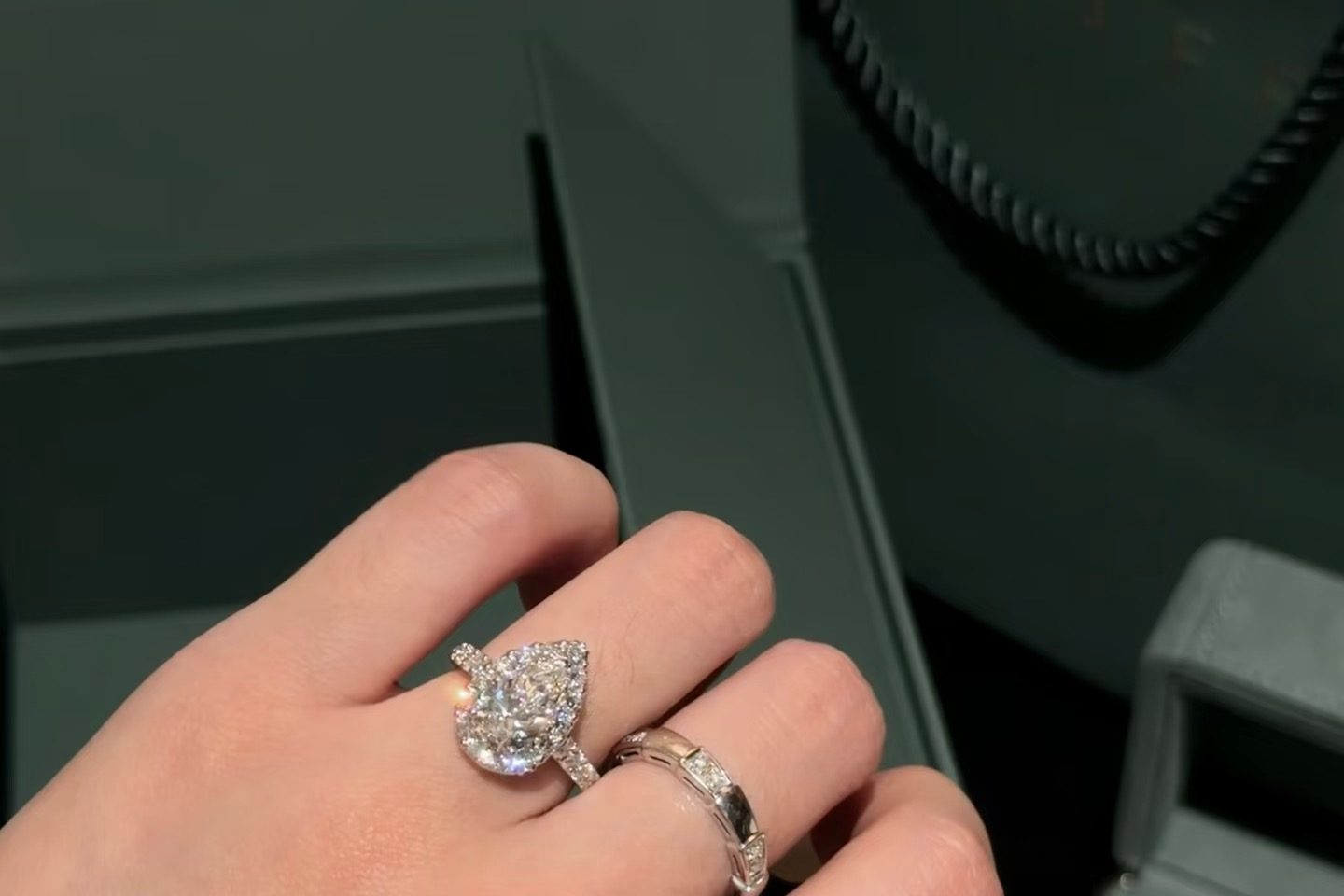
6. The single halo
Street price: $4,800–$8,200 Stone held by: centre in four or six prongs, surrounded by a ring of small stones
A halo makes a 0.75-carat centre stone read closer to 1.2 carats, which is a real and substantial gain. That is the entire case for it, and it is a good case if budget is the binding constraint.
The case against is maintenance economics. A typical single halo contains 16 to 24 melee stones, each held by two or four tiny prongs, each between 1.0mm and 1.8mm. When one falls out — and over ten years, several will — replacing it involves matching colour and cut on a stone worth perhaps $8, plus $40 to $80 of bench time. The repair is never economical; it is only necessary.
Also worth knowing: halos accumulate grime aggressively in the channel between centre stone and surround, and they need ultrasonic cleaning roughly monthly to keep looking right.
Where it fails: at the melee level, continuously. Budget for one repair every two to three years.
7. The hidden halo
Street price: $5,000–$8,600 Stone held by: centre in prongs, with a ring of stones set beneath the girdle
A hidden halo puts the small stones under the centre stone, where they are visible from the side rather than the top. It adds sparkle when the hand moves and does not inflate the top-down footprint. It is a good compromise for people who want detail without the dated look of a visible halo.
The structural note is that a hidden halo adds mass directly under the stone, raising the overall height of the ring. On a small finger that can push the stone uncomfortably high. Ask for the total height above the finger and compare it against the ring you tried on.
8. The double halo
Street price: $5,600–$9,400 Stone held by: centre, plus two concentric rings of melee
A double halo pushes apparent size further — a 0.75-carat centre can read as 1.5 carats — and roughly doubles the maintenance burden. It also creates a hard visual edge that reads as a distinct design statement rather than a subtle enhancement, which means it dates faster.
We list it because it is genuinely effective at its stated goal, and because it is the style most often regretted. If you are considering it, look at one on a hand in daylight rather than in showroom lighting before committing.
9. The cluster ring
Street price: $2,800–$5,500 Stone held by: several stones of similar size set closely together
A cluster uses multiple stones of comparable size rather than one centre with small surround, creating the illusion of a single larger stone. It is the most cost-efficient way to get visual size, and the least efficient way to get optical performance, because the stones are rarely cut to work together.
Where clusters genuinely shine is coloured stones and antique styles, where the arrangement reads as intentional design rather than as substitution. A Victorian five-stone cluster in old-cut diamonds is a beautiful object. A modern cluster pretending to be a solitaire is not.
Group three: vintage and period
10. Art Deco geometric
Street price: $4,400–$11,000 Stone held by: varies; typically four or six prongs with millgrain detailing
Art Deco rings — produced roughly 1920 to 1935, and reproduced constantly since — use hard geometry: octagonal and hexagonal outlines, stepped shoulders, calibrated stones, and often a strong central axis. The proportions were designed for old European and transitional cuts, which have smaller tables and higher crowns than a modern brilliant.
This creates a specific buying consideration. If you are setting a modern round brilliant into a reproduction Art Deco mounting, the stone will sit differently than the original design intended, and the ring will read slightly wrong to anyone who knows the period. If that does not bother you, fine. If it does, source an old European cut — they are available and often cheaper per carat than a modern brilliant of the same grade.
Where it fails: in original pieces, the millgrain wears smooth and the fine metalwork thins. Restoration is possible but skilled, and should not be entrusted to a generalist.
11. Edwardian filigree
Street price: $4,000–$12,000 Stone held by: delicate prongs within pierced metalwork
Edwardian rings are the lightest, most lace-like engagement rings ever made, achieved by piercing and engraving platinum to a degree that modern manufacturing does not attempt because it would not survive the retail environment. A good Edwardian ring weighs less than two grams and looks like spun sugar.
That delicacy is the entire point and the entire risk. These are not rings for daily wear in the modern sense. If you buy one, treat it as you would a piece of couture: wear it, enjoy it, and take it off before you do anything with your hands.
12. The Victorian three-stone
Street price: $3,600–$9,000 Stone held by: three stones in prongs, often with carved shoulders
Three-stone rings carry an obvious symbolic reading — past, present, future — and a practical one: the centre stone can be smaller while the overall ring reads generously. Victorian examples use old cuts, which have a soft, candlelit quality that modern brilliants do not reproduce.
The structural consideration is that side stones sit on the shoulders, exactly where a wedding band will want to sit. Expect a gap unless you commission a curved band or a band with a matching notch.
Group four: modern and architectural
13. The east-west setting
Street price: $4,200–$7,600 Stone held by: prongs, with an elongated stone rotated 90 degrees
An east-west setting turns an oval, marquise or emerald-cut stone sideways so its long axis runs across the finger rather than along it. The effect is architectural and unusually flattering on shorter fingers, because the horizontal line widens rather than lengthens the hand.
Two things to know. First, an east-west oval presents its two pointed ends to the sides of the finger, which are the most knock-prone positions; a bezel or half-bezel is a much better match for this orientation than prongs. Second, this style is the most sensitive of any on this list to band width — a narrow band makes it look like it is about to fall off.
14. The asymmetric / toi et moi
Street price: $5,000–$14,000 Stone held by: two stones, different sizes or cuts, set side by side
Two-stone rings allow for genuinely personal design: a birthstone next to a diamond, an heirloom stone next to a new one, an emerald cut next to an oval. The style saw a large commercial revival after 2019 and remains the most-requested bespoke brief we see.
The practical caution is balance. Two stones of different heights and weights create a ring that is heavier on one side and rotates on the finger. A competent jeweler solves this with a weighted band and careful placement, but it must be designed for, not discovered later.
15. The full eternity band as an engagement ring
Street price: $3,400–$8,000 Stone held by: shared prongs around the entire circumference
An eternity band worn as the engagement ring is the most comfortable and lowest-maintenance-looking option here, and it is quietly one of the least practical. Shared-prong eternity settings hold each stone with metal from the neighbouring stone's setting, which means the loss of one stone can loosen its neighbours.
The second problem is sizing. A full eternity band cannot be resized without rebuilding the setting, because there is no plain metal to work with. If your ring size changes — and it will, with weight, temperature and age — you are looking at a full remount rather than a resize. A half-eternity, with plain metal on the palm side, resizes normally and costs roughly 60 percent as much. That is the version we recommend.