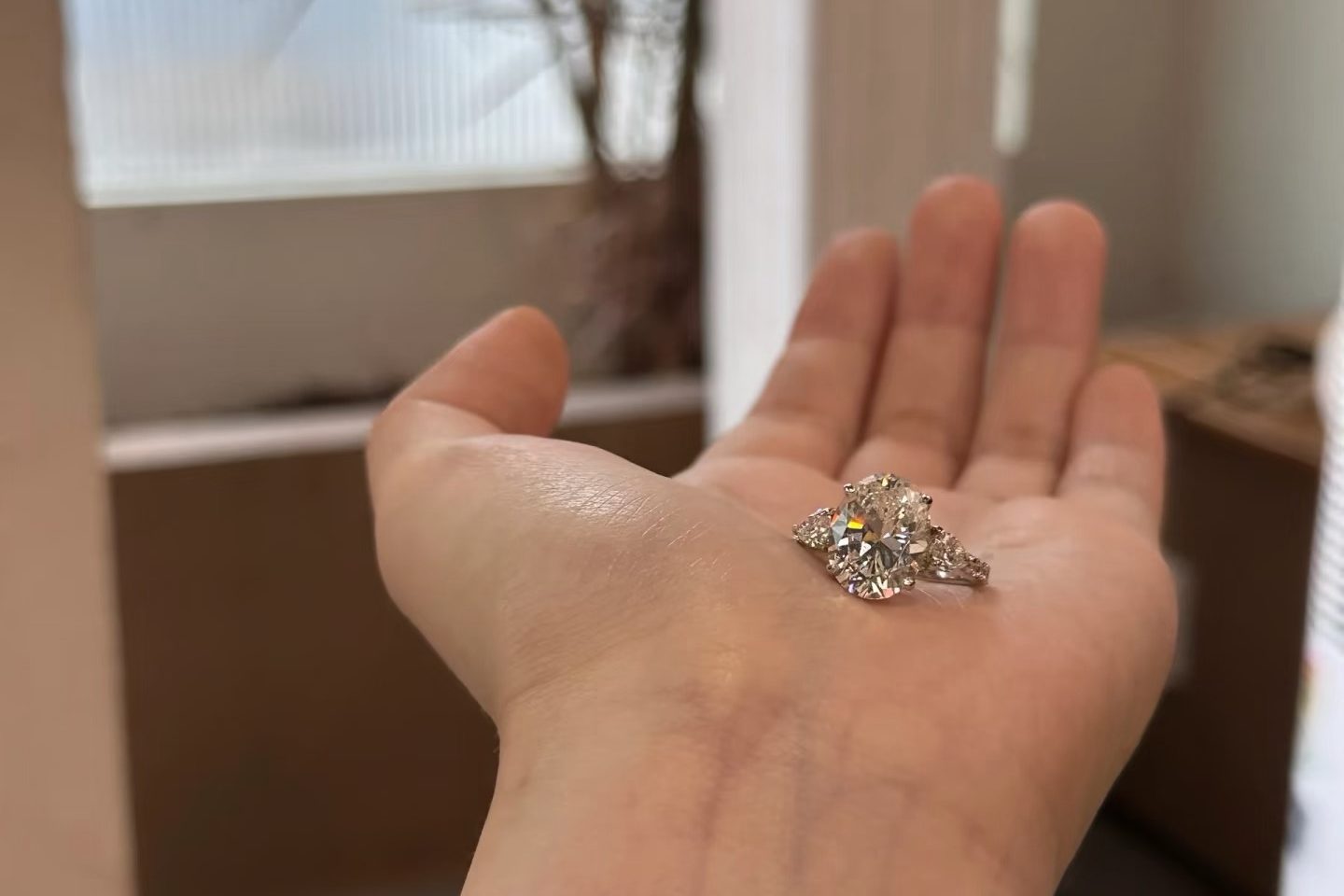
Cut is the only one of the four Cs that the diamond itself does not determine. Colour, clarity and carat weight are properties of the rough — a gift of geology. Cut is a decision, made by a planner in Antwerp, Mumbai or Tel Aviv, about how to spend a piece of rough to best effect.
That decision is where most of the beauty in a finished diamond is won or lost, and it is the C that buyers understand least. This guide covers every major cut in commercial production: what each one does with light, what proportions matter, what each costs relative to a round brilliant, and where each one fails.
How a diamond handles light
Before the shapes, the physics — because every cut is an argument about the same three behaviours.
Brilliance is white light returned to the eye from the crown. It is a function of how much light entering the stone is reflected back out rather than leaking through the pavilion. This is almost entirely determined by pavilion angle.
Fire is white light split into spectral colours. It happens when light is dispersed inside the stone and exits at different angles for different wavelengths. Fire is most visible in dim, directional light — candlelight, a single spotlight — and least visible under flat office lighting.
Scintillation is the pattern of light and dark that moves as the stone moves. It is created by contrast between adjacent facets, and it is the reason a well-cut stone looks alive in the hand while a poorly cut one looks flat even though both are equally bright on paper.
A cut is good when it balances these three. Push pavilion depth for maximum brilliance and you lose fire. Shallow the crown for a bigger-looking table and you lose scintillation. Every shape below is a different answer to that trade-off.
Reading a certificate
The GIA cut grade — Excellent, Very Good, Good, Fair, Poor — is only issued for round brilliants. For fancy shapes, GIA reports polish, symmetry and fluorescence but does not grade cut. This means that for ovals, emeralds, pears and the rest, you must evaluate proportions yourself or rely on a vendor who publishes them.
The round brilliant
Facets: 57 (58 with a culet)
Rough retained: 40–45%
Price vs round brilliant: baseline
Best at: brilliance and scintillation
The round brilliant is the reference standard, and everything else in this guide is priced against it. Its geometry was derived mathematically through the twentieth century — Marcel Tolkowsky's 1919 calculations are the famous starting point — and it remains the only cut with a consensus ideal.
The proportions that matter
| Parameter |
Ideal range |
What it controls |
| Table % |
54–57 |
Brightness versus fire. Larger table, more white light, less dispersion |
| Crown angle |
33.5–35.5° |
Fire and the size of the crown's light-gathering surface |
| Pavilion angle |
40.6–41.8° |
Brilliance. Below 40.6° light leaks; above 41.8° light concentrates centrally |
| Total depth |
59–62.3% |
Overall light return. Too deep and the stone darkens at the centre |
| Girdle thickness |
3–4% |
Durability. Too thin and the girdle chips; too thick and it wastes weight |
| Culet |
None |
A visible culet shows as a dark dot through the table |
The single most important number is the pavilion angle, and the single most useful check is how it pairs with the crown angle. A 41.0° pavilion with a 34.5° crown is a well-balanced stone. A 41.0° pavilion with a 31° crown is a flat-topped stone that will look bright but dead. If a vendor will not give you both angles, that is itself information.
What to watch for
A round brilliant is the hardest cut to buy badly, because the cut grade screens most of the risk. The remaining traps are painting and digging — techniques that fudge a poor crown angle by tilting the upper girdle facets to hide light leakage — and excessive girdle thickness, where the lab may still award Excellent cut but a visible proportion of your carat weight sits in a band of unpolished metal. A girdle at 4.5% or above is worth avoiding on a stone you are paying by weight for.
The oval
Facets: 57–58
Rough retained: 50–55%
Price vs round brilliant: 5–15% less
Best at: apparent size per carat
The oval has become the dominant fancy shape of the last five years, and the reason is straightforward: it looks bigger than a round of the same carat weight, because its length covers more of the finger. A well-proportioned 1.00-carat oval reads closer to a 1.20-carat round.
The proportions that matter
| Parameter |
Recommended |
Notes |
| Length-to-width ratio |
1.35–1.50 |
Below 1.30 reads round; above 1.55 reads narrow and can bow-tie |
| Table % |
54–60 |
Wider range acceptable than in a round |
| Depth % |
59–63% |
Shallower stones may leak light at the ends |
| Girdle |
Medium to slightly thick |
Ovals are prone to end chips; thin girdles are risky |
The bow-tie problem
Almost every oval diamond shows a bow-tie — a dark, bow-shaped band across the middle where light leaks through the pavilion. The question is not whether it exists but how visible it is. A faint bow-tie visible only at certain angles is normal and acceptable. A bow-tie that reads as a dark bar under normal lighting means the stone is cut too shallow in the pavilion, and no setting will hide it.
Judge this in person, or ask for video shot face-up on a plain background in diffuse daylight. Photographs taken under studio lighting with a bright surround will hide a bow-tie entirely.
The emerald cut
Facets: 57–58 (step cut)
Rough retained: 60–65%
Price vs round brilliant: 10–20% less at equal grade
Best at: clarity, elegance, a hall-of-mirrors effect
The emerald cut is a step cut: rectangular facets arranged in concentric rows, parallel to the outline. It produces long, broad flashes of light rather than sparkle, and an effect best described as a hall of mirrors.
Why it demands better material
Step facets are large and flat, which means there is nowhere for imperfection to hide. A clarity characteristic that would be invisible in a round brilliant's facet pattern can be plainly visible in an emerald cut. The same is true of colour — a J-colour emerald cut reads several grades warmer than a J-colour round, because the large facets give the tint more surface to show against.
The practical rule: buy emerald cuts one to two grades higher in colour and clarity than you would buy a round brilliant, and expect the price difference to narrow considerably as a result.
The proportions that matter
| Parameter |
Recommended |
Notes |
| Length-to-width ratio |
1.40–1.55 |
The classic emerald cut proportion |
| Table % |
61–69 |
Step cuts normally have larger tables than brilliants |
| Depth % |
61–67% |
Shallow step cuts go glassy and lose contrast |
| Corners |
Clearly clipped |
Sharper corners chip; the clip should be visible but not large |
The pear
Facets: 56–58
Rough retained: 50–55%
Price vs round brilliant: 5–15% less
Best at: apparent size, elongating the finger
A pear is a hybrid: a round brilliant's pavilion married to a marquise's point. It gives the size advantage of an elongated shape with more of the round's light behaviour.
The critical specification is symmetry, and specifically the alignment of the point with the centre of the rounded end. An off-centre point is immediately visible and cannot be corrected by setting. Pears also have a high incidence of bow-ties, because the pavilion must transition from round to pointed across the length of the stone.
Pears are directional in a way most shapes are not. Worn with the point toward the fingertip, they lengthen the hand. Worn point-inward, they shorten it. This is worth testing with a placeholder before you commit.
The marquise
Facets: 56–58
Rough retained: 45–50%
Price vs round brilliant: 5–20% less
Best at: maximum apparent size per carat
The marquise covers more finger length per carat than any other shape, which is why it has never gone fully out of fashion despite being one of the hardest cuts to buy well.
It has two structural weaknesses. The points are vulnerable to chipping and should always be set with prongs protecting them — a V-prong at each end, not a round prong. And the bow-tie is more likely and more prominent than in any other shape, because the pavilion must be elongated dramatically.
If you are buying a marquise, insist on seeing it face-up in daylight and reject anything where the dark band reads as a solid shape rather than a faint suggestion.
The cushion
Facets: 58 (brilliant) or 61 (crushed ice)
Rough retained: 55–60%
Price vs round brilliant: 10–20% less
Best at: softness, a vintage read
The cushion — a rounded square — comes in two distinct styles that are often confused. The brilliant cushion has a defined facet pattern with a visible table and crisp contrast. The crushed-ice cushion has smaller, more randomly arranged facets that produce a soft, glittery, almost hazy effect.
Crushed-ice cushions are popular and often beautiful, but they hide light performance problems. A crushed-ice cushion can look sparkly while actually leaking a great deal of light. If you want a cushion with genuine optical quality, buy a brilliant-style cushion and accept the slightly more formal look.
The asscher
Facets: 58 (step cut, square outline)
Rough retained: 60–65%
Price vs round brilliant: 10–25% less
Best at: architecture, symmetry
The asscher is an emerald cut in a square outline, with a length-to-width ratio between 1.00 and 1.05 and cut corners. Its charm is its geometry — concentric squares visible through the stone — and its geometry is also its demand: the cut is unforgiving of any asymmetry, because a square outline makes deviation obvious.
Like the emerald cut, it needs high colour and clarity, and like the emerald cut, it does not sparkle in the conventional sense. It flashes.
The radiant
Facets: 70 (brilliant-style with cut corners)
Rough retained: 55–60%
Price vs round brilliant: 10–20% less
Best at: sparkle in a rectangular outline
The radiant was developed in the 1970s to combine a rectangular outline with brilliant-style faceting. It succeeds: a radiant is the sparkliest rectangular cut available. The cost is that the facet pattern can look busy, and the cut corners — which exist to protect the stone — reduce the apparent size.
The heart
Facets: 56–58
Rough retained: 40–45%
Price vs round brilliant: variable; often at a premium
Best at: symbolism
The heart cut is the most difficult shape to cut well and the most immediately judged. Symmetry is everything: the two lobes must be equal, the cleft must be centred and clean, and the point must align with the cleft. A heart with an off-centre cleft is not a subtle flaw — it is the first thing anyone sees.
Rough retention is poor, which is why hearts are rarely a value proposition. Buy them for the symbol, and inspect the symmetry with more care than you would any other shape.
Comparison: the price of shape
The table below shows what a 1.00-carat, G colour, VS2 stone typically costs across shapes in 2026, expressed as a percentage of the round brilliant price.
| Shape |
Price vs round |
Apparent size vs round |
Rough retained |
Cut graded by GIA? |
| Round brilliant |
100% |
Baseline |
40–45% |
Yes |
| Oval |
85–95% |
+15–20% |
50–55% |
No |
| Emerald |
80–90% |
+10–15% |
60–65% |
No |
| Pear |
85–95% |
+15–20% |
50–55% |
No |
| Marquise |
80–95% |
+20–25% |
45–50% |
No |
| Cushion |
80–90% |
+5–10% |
55–60% |
No |
| Asscher |
75–90% |
−5–10% |
60–65% |
No |
| Radiant |
80–90% |
+5% |
55–60% |
No |
| Heart |
95–115% |
+5% |
40–45% |
No |
Two conclusions follow from this table. First, if you are optimising for the largest-looking stone for a given budget, the marquise and the pear are the efficient choices. Second, the absence of a GIA cut grade for every fancy shape is the single biggest reason buyers overpay: you are being asked to judge light performance without a standardised measure of it.
How to judge a cut you cannot measure
When there is no cut grade, work through these four checks.
1. Ask for the proportions. A reputable vendor will supply table percentage, depth percentage, crown angle, pavilion angle and girdle thickness. If they cannot, the stone has not been assessed properly.
2. Look at it face-up in diffuse daylight. Not showroom spotlight, not a light box. Take it to a window. This is where bow-ties appear and where a stone that looked brilliant under LEDs goes grey.
3. Turn it and watch the contrast. A well-cut stone produces sharp, moving patterns of light and dark. A poorly cut one either goes uniformly bright — a sign of a shallow pavilion leaking light — or shows large static dark areas.
4. Compare two stones of the same shape side by side. Cut quality is easiest to judge comparatively. Put a well-cut stone next to a mediocre one and the difference is obvious in seconds, in a way that no single stone in isolation reveals.
Cut and the other three Cs
Cut is not a fourth characteristic sitting alongside colour, clarity and carat. It is the one that governs how much the other three matter, and this changes the priority order in a way that most buying advice gets wrong.
Cut against carat. A well-cut 0.90-carat stone spreads its weight across the crown, where it is visible, and returns light efficiently. A poorly cut 1.00-carat stone often carries extra weight in the pavilion, where it is invisible from above, and leaks light. In a side-by-side comparison the 0.90-carat stone usually looks larger and is always brighter. Since pricing steps up sharply at the one-carat threshold, the well-cut 0.90 is both the better stone and the cheaper one.
Cut against colour. A bright, well-cut stone returns more white light to the eye, which masks a slight body tint. A poorly cut stone concentrates light internally and goes dark, which makes the same tint more obvious. This is why a J-colour excellent-cut stone can look whiter than an H-colour stone with a shallow pavilion. If you are trying to save money on colour, buy a better cut first and then drop the colour grade.
Cut against clarity. A well-cut stone's facet pattern breaks up the view into the interior, so inclusions are less noticeable. A shallow stone with a large table gives you a clearer window straight into the middle of the stone, where an SI2 inclusion suddenly becomes visible. This is the mechanism behind a common surprise: a stone that was certified SI2 and looked fine in the shop looks included once mounted in a different setting, because the setting changed how light enters.
The practical consequence of all three is a single rule: when the budget is fixed, cut is the last thing to compromise and carat is the first.
Common mistakes when buying by cut
Buying the certificate rather than the stone. Two stones can both carry a GIA "Excellent" cut grade and look different, because the grade is a range rather than a point. A stone at the edge of the excellent range — a 41.8° pavilion with a 33.5° crown — behaves differently from one in the middle. If you are spending meaningfully, ask for the actual angles and compare them against the ranges above.
Trusting a photograph. Studio photography uses a bright surround and controlled lighting that flatters every stone. Bow-ties disappear, leakage disappears, and colour is neutralised. Ask for video, shot face-up on a plain background in diffuse daylight, or see the stone in person.
Ignoring the girdle. A very thin girdle is a chip waiting to happen; an extremely thick girdle is weight you paid for that you cannot see. Both can sit inside an Excellent cut grade. Ask for the girdle description and stay between "medium" and "slightly thick".
Assuming a fancy shape is priced fairly because the cut grade is absent. For fancy shapes there is no cut grade to anchor the price, which means the market prices them on appearance and brand rather than on measured performance. This is where the widest quality variation exists, and where a knowledgeable buyer has the most advantage.
Buying a "crushed ice" cut for the sparkle. Crushed-ice cushions and radiants produce a soft, glittering effect that photographs beautifully and can conceal substantial light leakage. If you want genuine optical performance, buy a cut with a defined facet pattern and visible contrast.
Frequently asked questions
Which diamond cut is the most brilliant?
The round brilliant, by a measurable margin. Its 57 or 58 facets are arranged to return the maximum amount of light to the viewer, and it is the only cut with a mathematically derived set of ideal proportions. An excellent-cut round brilliant will outperform any fancy shape of the same colour and clarity in a side-by-side comparison.
What is the difference between cut and shape?
Shape is the outline — round, oval, emerald. Cut is how well the stone is fashioned within that outline: the angles, the symmetry, the polish and the proportions. Two oval diamonds of the same shape can differ by 30 percent in price purely because of cut quality.
Are emerald cut diamonds less sparkly?
Yes, deliberately. An emerald cut uses long step facets rather than small brilliant facets, which produces broad flashes of light and a hall-of-mirrors effect instead of pinfire sparkle. It is a different aesthetic, not a worse one, but it demands higher colour and clarity because the large flat facets make inclusions and colour visible.
Why is a 1-carat oval cheaper than a 1-carat round?
Because far more rough diamond is lost cutting a round brilliant. A round brilliant retains roughly 40 to 45 percent of the rough, while an oval retains 50 to 55 percent. Less waste means lower cost per carat, and it is also why ovals look larger than rounds of the same weight.
What cut proportions should I look for in a round brilliant?
Table between 54 and 57 percent, crown angle between 33.5 and 35.5 degrees, pavilion angle between 40.6 and 41.8 degrees, total depth between 59 and 62.3 percent, and a girdle thickness between 3 and 4 percent. These ranges, combined with excellent symmetry and polish, define the GIA excellent cut grade.
The bottom line
Cut is where your money buys the most visible difference and where most buyers spend the least attention. The practical rules are short: buy a round brilliant if you want the maximum optical performance and the safety of a published cut grade; buy an oval or pear if you want the most size for your money; buy an emerald or asscher if you value geometry over sparkle and are willing to pay for the colour and clarity those cuts demand.
Whatever shape you choose, the same three numbers decide whether it was cut well — pavilion angle, crown angle and girdle thickness. Ask for them. A vendor who supplies them readily is a vendor worth buying from.