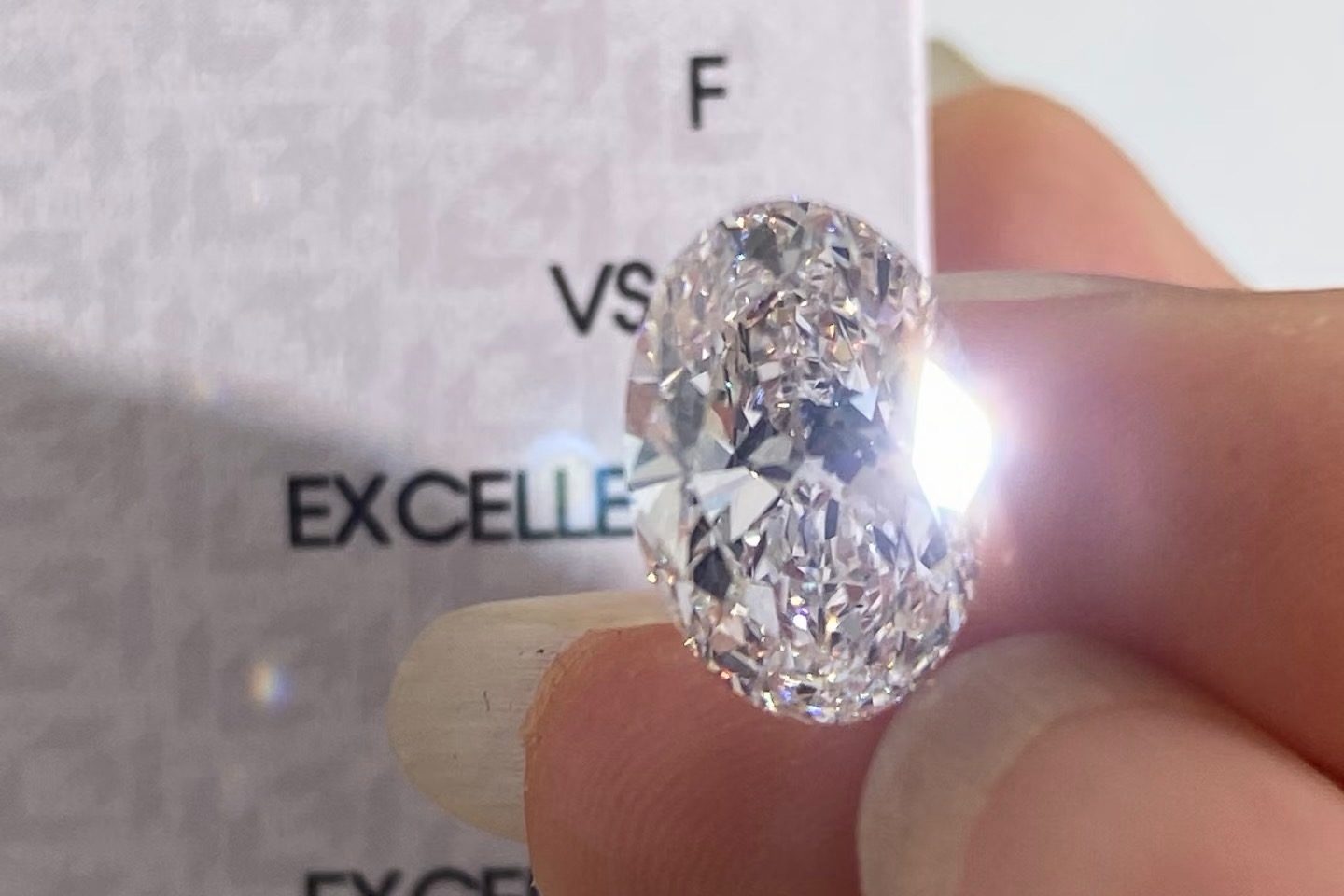
The lab-grown diamond is the most consequential change in the jewelry trade in fifty years, and it has produced two equally unhelpful responses: that it is exactly the same thing for less money, and that it is a fake.
Both are wrong in ways that cost people money. This guide sets out what lab-grown diamonds actually are, where the two markets genuinely differ, and how to make a decision you will still be comfortable with in ten years.
What a lab-grown diamond is
A diamond is a lattice of carbon atoms arranged in a specific crystal structure. Nothing about that definition mentions where it formed or how long it took.
Lab-grown diamonds are crystalline diamond, made in a reactor by one of two methods.
HPHT (high pressure, high temperature) replicates the conditions of the earth's mantle: roughly 1,500°C and 60,000 atmospheres, with a metal solvent catalyst. It is the older method and the one that produces the blue and yellow stones that dominated early lab-grown supply.
CVD (chemical vapour deposition) starts with a thin diamond seed plate in a vacuum chamber, heated to around 900°C, and introduces carbon-bearing gas that deposits layer by layer onto the seed. CVD produces most of the colourless material sold today.
Both methods produce diamond. The resulting stone has the same hardness (10 on the Mohs scale), the same refractive index (2.417), the same dispersion, the same thermal conductivity, and the same chemical composition. If you could not see its certificate, you could not tell it apart from a mined stone.
What is genuinely different
Three things, and only three.
Growth features. Lab-grown diamonds contain inclusions that do not occur in nature — metallic flux particles in HPHT stones, and distinctive striated or "graining" patterns in CVD stones. These are how laboratories identify them. They are not visible to the naked eye or with a loupe.
Price trajectory. This is the real difference, and it is not about the stone's quality. It is about supply.
Resale behaviour. Which follows directly from the price trajectory.
The price collapse
The single most important fact about lab-grown diamonds is not that they are cheaper. It is that they are getting cheaper, fast, and have not stopped.
| Year |
Typical price, 1ct G VS2 excellent round |
Change |
| 2018 |
$4,000 |
— |
| 2020 |
$2,800 |
−30% |
| 2022 |
$2,200 |
−21% |
| 2024 |
$1,600 |
−27% |
| 2026 |
$1,200–$2,000 |
broadly flat, still drifting |
Over the same period, natural diamond prices of the same specification moved from roughly $6,200 to roughly $6,000 — essentially flat, with some softness in the 1-carat category and firmness above 3 carats.
The mechanism is straightforward. Lab-grown diamond is a manufactured product, and manufacturing costs fall as capacity scales and technology improves. Natural diamond supply is constrained by geology. The two markets are structurally different, and pretending otherwise is the source of most bad advice on this topic.
What this means for resale
The practical consequence: a lab-grown diamond has almost no resale market.
This is not a moral judgement about the stone. It is arithmetic. Nobody buys a used lab-grown diamond when a new one, with a warranty and a fresh certificate, costs the same or less. Pawn shops and estate buyers generally will not take them. Some jewelers will accept them as trade-in credit against another purchase, at a substantial discount.
A natural diamond does not hold value well either — you should expect to recover 30 to 50 percent of retail on resale — but it recovers something, and it does so reliably.
If you are choosing between the two, this is the decision, stated plainly: lab-grown is cheaper now, natural is worth more later. Everything else is detail.
Where the two markets genuinely differ
|
Natural |
Lab-grown |
| Chemical composition |
Carbon |
Carbon |
| Mohs hardness |
10 |
10 |
| Refractive index |
2.417 |
2.417 |
| Price, 1ct G VS2 |
~$6,000 |
$1,200–$2,000 |
| Price trend since 2018 |
Flat |
−70% |
| Resale recovery |
30–50% of retail |
Near zero |
| Certification |
GIA, IGI, HRD, AGS |
IGI, GCAL, GIA (limited) |
| Laser inscription |
Report number |
Report number + "LABORATORY-GROWN" |
| Typical growth time |
1–3 billion years |
2–4 weeks |
| Insurance replacement |
Appreciates with market |
Falls with market |
| Availability above 5ct |
Common |
Possible but expensive to grow |
The insurance row deserves a note. Insurers replace on a like-for-like basis. For a natural diamond, the replacement cost tends to rise over time, and some policies reflect that. For a lab-grown stone, the replacement cost falls, so a policy written at purchase price will be over-insured within a couple of years — and you will have paid premiums on value that no longer exists. Re-appraise a lab-grown piece every two to three years and adjust the cover down.
What lab-grown diamonds are good for
The case for lab-grown is stronger than the trade usually admits, in specific circumstances.
Maximising size on a fixed budget. This is the strongest argument. A $6,000 budget buys a 1-carat natural stone or a 3-carat lab-grown one. If the point of the ring is the presence of a large stone, lab-grown delivers something no natural purchase can at that price.
Coloured stones. Lab-grown fancy colours — particularly vivid pinks and blues — cost a small fraction of natural equivalents, which are among the most expensive objects in the trade. If you want a pink diamond and not a pink diamond investment, lab-grown is the only rational route.
Matching and multiples. Earrings, tennis bracelets and eternity bands need many stones of matched colour and clarity. Natural matching is expensive and slow; lab-grown matching is easy.
Stones you intend to keep forever. If the piece will never be sold, the resale argument evaporates. Many buyers are in exactly this position, and for them the resale point is theoretical.
Avoiding mining entirely. For some buyers this is the whole decision, and it is a legitimate one. The ethical picture is genuinely more favourable on labour and conflict questions, though the environmental picture is more nuanced than the marketing suggests.
What natural diamonds are good for
Anything with a resale or investment dimension. If there is any chance you will sell, trade up or pass the piece on, natural is the only option that behaves sensibly.
Heirloom intent. A ring intended to be inherited is a ring whose value will be assessed by someone else, decades from now. A natural stone will be worth something. A lab-grown stone will be worth approximately the cost of the setting.
Larger, higher-quality goods. Lab-grown production is heavily weighted toward small and mid-size colourless stones. Above about 5 carats, and in the highest colour and clarity grades, natural supply is deeper and lab-grown premiums narrow considerably.
Buyers who want the stone to be a store of value in the insurance schedule. As above: natural replacement cost rises, lab-grown falls.
How to tell them apart — and how not to
You cannot identify a lab-grown diamond by eye, with a loupe, or with a standard diamond tester. Thermal testers, which are the common tool at a jewelry counter, will read both as diamond, because both are diamond.
Identification requires one of:
- A spectroscopy-based tester. The GIA iD100 and De Beers SYNTHdetect are the common instruments. Many reputable retailers have one.
- Laboratory analysis. A grading report from IGI, GCAL or GIA that states origin. This is the definitive answer.
Two practical protections:
Insist on a certificate that states origin. Since 2019, GIA has described lab-grown stones as "Laboratory-Grown Diamond" on the report, and they are laser-inscribed on the girdle with that wording. IGI reports use a different report format and prefix. A stone without a report stating origin is a stone whose origin you do not know.
Check the inscription yourself. A jeweler should be willing to show you the girdle inscription under a loupe or on a screen. It takes thirty seconds.
The misrepresentation problem
There is a real market in misrepresented stones — lab-grown sold as natural, particularly online and in markets with weak consumer protection. The tell is usually price: a "natural" 1-carat G VS2 at $1,800 is not a bargain, it is either a lab-grown stone or a natural stone of far worse quality than described.
If the price seems too good for natural, ask for the report number and verify it directly on the laboratory's website. Every major laboratory offers free report verification.
Making the decision
Work through these four questions in order. They resolve the choice for most buyers.
1. Will this piece ever be sold, traded or inherited?
If yes, and if the value matters, buy natural. If it will be worn until it is lost or given away, this question is moot.
2. What matters more — size or retained value?
$6,000 buys 1 carat natural or 3 carats lab-grown. Both are legitimate preferences, but they are different purchases, and you cannot have both.
3. How do you feel about the price trajectory?
If watching the value of a purchase fall by 70 percent over five years would bother you — even if you never sell — buy natural. If you think of it as the price of a consumer good, like a car, lab-grown is fine. This is a psychological question as much as a financial one, and it is the question most buyers underestimate.
4. Are you buying coloured, matched, or very large?
Coloured and matched sets: lab-grown is clearly better value. Above 5 carats: natural supply is deeper, and lab-grown premiums narrow.
Our position
We do not think either choice is wrong. We do think that buying lab-grown while believing it will hold value is a mistake, and that buying natural while resenting the price is a mistake. Decide which trade-off you are accepting, and the rest is straightforward.
Buying well in either market
In natural diamonds, the priority order is cut, then carat, then colour, then clarity. Buy the best cut you can afford; it is the only C that is fully under human control and the only one that determines how the stone looks.
In lab-grown diamonds, the priority order changes. Cut still matters, but colour and clarity are almost always excellent in lab-grown production, because it is cheaper to grow a clean, colourless stone than to work around flaws. The variables that actually differentiate lab-grown stones are cut quality and growth method. Ask whether a stone is CVD or HPHT, and ask for the cut proportions.
In both markets, insist on a report from a recognised laboratory, verify the report number independently, and confirm the laser inscription. Those three steps eliminate nearly every way of being misled.
The environmental question, in detail
Both industries publish favourable numbers, and the honest answer is that the comparison depends almost entirely on where the electricity comes from.
Mining moves enormous quantities of rock for a small quantity of diamond. The industry figure is roughly 250 tonnes of ore per carat recovered, though this varies by a factor of ten between operations. The energy is largely diesel for haulage and crushing. Mines also have land, water and biodiversity impacts that are difficult to express as a single number, and rehabilitation after closure is often incomplete.
Growing moves almost no rock, but consumes very large amounts of electricity. CVD and HPHT reactors run continuously for two to four weeks at high temperature and pressure. The carbon footprint of a lab-grown stone is therefore essentially a function of the grid it was grown on: the same stone produced with hydroelectric power has a fraction of the footprint of one grown on a coal-heavy grid, and both are sold as "lab-grown diamond" with no distinction made.
The honest summary:
| Dimension |
Natural |
Lab-grown |
| Land disturbance |
High, localised |
Very low |
| Water use |
High in some regions |
Low to moderate |
| Energy intensity |
Moderate, mostly diesel |
High, mostly electricity |
| Carbon footprint |
Depends on mine and location |
Depends entirely on the grid |
| Labour conditions |
Variable; Kimberley Process covers conflict, not conditions |
Regulated industrial settings |
| Long-term remediation |
Often incomplete |
Minimal impact to remediate |
Two conclusions. First, a blanket claim that lab-grown is more sustainable is not supportable without knowing the power source. Second, a blanket claim that natural is more sustainable because mines rehabilitate is not supportable either. If the environmental dimension is decisive for you, the useful question to a vendor is which grid powered the reactor — and most will not know.
How to shop each market
The two markets reward different behaviour.
Insist on a report from GIA, HRD or AGS. These are the laboratories whose grades the market trusts and whose report numbers you can verify free of charge on their websites. IGI is widely used and generally reliable, but its grades are softer — a stone graded VS2 by IGI may grade SI1 at GIA. That is not fraud; it is a difference in standard, and it matters when you resell.
Verify the report number independently. Do this before you pay, not after. Every major laboratory offers free online verification. It takes two minutes and it eliminates the most common form of misrepresentation.
Ask for the actual proportions, not just the cut grade. Table, depth, crown angle and pavilion angle. A stone graded Excellent at the edges of the range looks different from one in the middle.
Ask about treatments. Laser drilling and fracture filling must be disclosed. A clarity-enhanced stone costs 30 to 50 percent less than an untreated one and requires different care.
Check the girdle inscription. Under a loupe, you should be able to read the report number on the girdle. If a jeweler will not show you, that is a reason to leave.
Certification matters less, but cut matters more. Because colour and clarity are almost always excellent in lab-grown production, the variables that differentiate one stone from another are cut quality and growth method. Ask for the proportions.
Ask whether it is CVD or HPHT. CVD is now dominant for colourless material. HPHT stones can carry a faint blue or yellow tint and occasionally contain metallic flux inclusions. Neither is better in principle, but you should know which you are buying.
Check the price against the trend, not against natural. A lab-grown stone priced at 40 percent of a natural equivalent in 2026 is expensive. The current range is 20 to 40 percent, and falling.
Buy the setting with resale in mind. Since the stone has no resale market, the setting is the only part of the ring that retains any value. A plain 14K or platinum setting can be reused or sold; an elaborate custom mounting cannot.
Re-appraise every two to three years. Your insurance cover was written at purchase price, and the replacement cost is falling. Adjust the cover downward or you are paying premiums on value that no longer exists.
Terms you will meet
| Term |
Meaning |
| CVD |
Chemical vapour deposition. The dominant method for colourless lab-grown diamond |
| HPHT |
High pressure, high temperature. The older method; also used to treat natural stones |
| As-grown |
A lab-grown stone sold without post-growth treatment |
| Type IIa |
Diamond with no detectable nitrogen. Rare in nature, common in lab-grown |
| Melee |
Small diamonds under about 0.2 carats, often sold in parcels |
| Parcel |
A lot of stones sold together, usually melee |
| Girdle inscription |
The laser-etched text on a stone's edge, carrying its report number and origin |
| Clarity enhancement |
Laser drilling and fracture filling, used to improve apparent clarity |
| Origin report |
A laboratory report that states whether a stone is natural or laboratory-grown |
| Trade-in |
Credit given by a retailer against a future purchase, usually at a fraction of original value |
The two terms that matter most when you are shopping are girdle inscription and origin report. Together they answer the only question that cannot be settled by looking at the stone.
Frequently asked questions
Are lab-grown diamonds real diamonds?
Yes. They are crystalline diamond — the same carbon lattice, the same hardness of 10 on the Mohs scale, the same refractive index and dispersion. The difference is origin: one formed in the earth over billions of years, the other in a reactor over weeks. No optical instrument can reliably distinguish them without laboratory equipment.
Do lab-grown diamonds hold their value?
Poorly, and this is the single most important difference. Lab-grown prices have fallen roughly 75 percent since 2018 and continue to decline as production capacity grows. Natural diamond prices are broadly flat over the same period. If resale or insurance value matters to you, buy natural.
How much cheaper are lab-grown diamonds?
Roughly 60 to 80 percent less than a natural diamond of the same cut, colour, clarity and carat weight as of 2026. A 1.00-carat G VS2 excellent-cut round brilliant that costs around $6,000 natural typically costs $1,200 to $2,000 lab-grown.
Can a jeweler tell a lab-grown diamond from a natural one?
Not by eye and not with a standard loupe. Identification requires laboratory equipment — usually a spectroscopy-based tester such as the GIA iD100 or a De Beers SYNTHdetect, or full analysis by a grading laboratory. This is why lab-grown stones must be laser-inscribed and certified as laboratory-grown.
Are lab-grown diamonds ethical?
On labour and conflict questions, generally yes — no mining is involved, and production is concentrated in the United States, China and India under regulated industrial conditions. On environmental questions the answer is more complicated: growing diamond requires very large amounts of electricity, so the carbon footprint depends almost entirely on whether that electricity is renewable.
The bottom line
Buy lab-grown if you want the largest, most beautiful stone your budget can produce, you intend to keep the piece, and you are comfortable treating it as a purchase rather than an asset. Buy natural if resale, inheritance or the feeling of holding something the earth made matters to you — and accept that you will get a smaller stone for the same money.
What you should not do is buy lab-grown expecting natural behaviour, or buy natural resenting the premium. Both markets are honest about what they offer. The confusion comes from buyers who have not decided which one they are in.