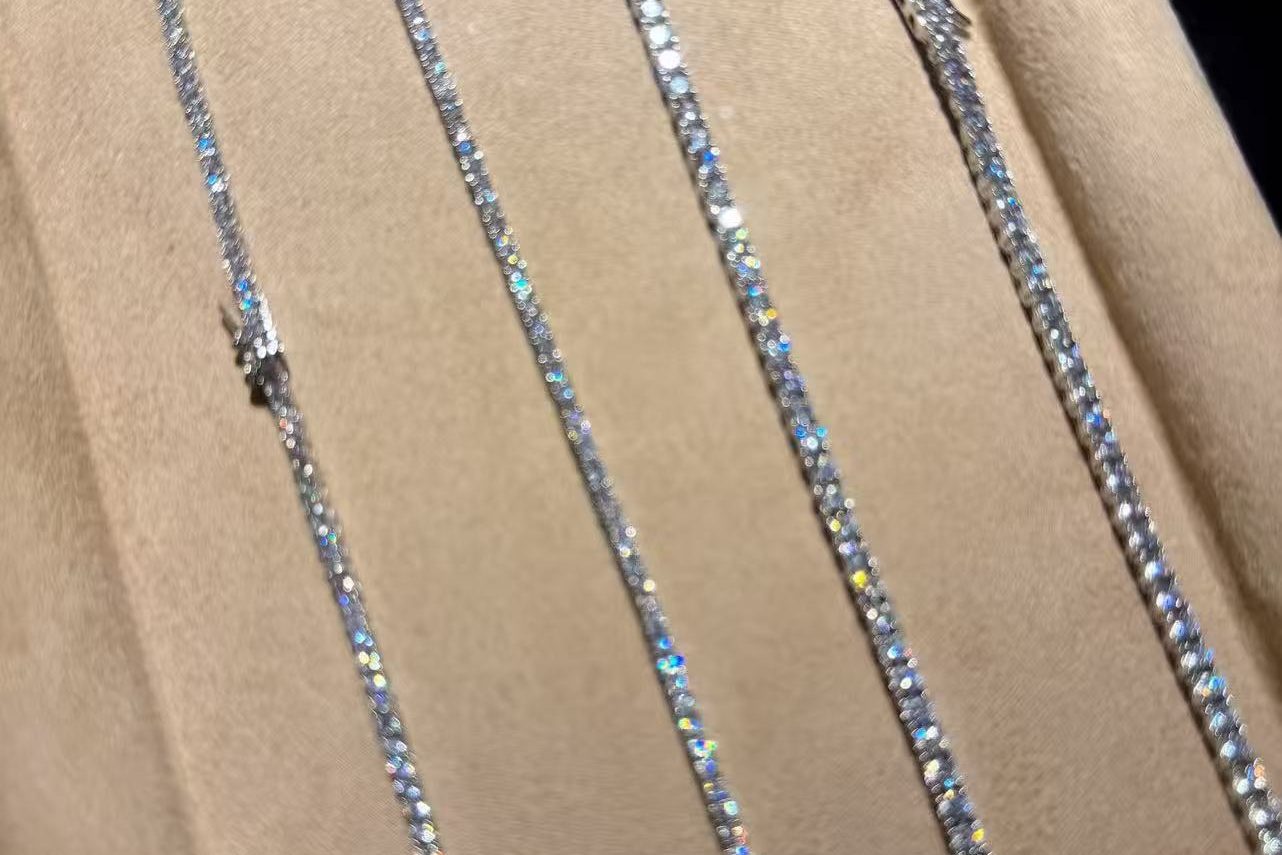
A tennis bracelet is the most mechanically complex piece of jewelry most people will ever own. A typical one has forty to fifty stones, each in its own setting, connected by a hundred or more small joints, held on the wrist by a clasp that has to survive being caught on a sleeve several times a week.
That complexity is the whole story of the category. Tennis bracelets are not hard to make beautiful. They are hard to make durable, and the difference between a bracelet that survives a decade and one that sheds stones in the first year is entirely in the construction, not in the stones.
What a tennis bracelet is, and where the name came from
A tennis bracelet is a single continuous line of individually set stones of matching size and cut, linked so that the whole piece articulates and lies flat against the wrist. The defining features are the line — one row, no clusters or halos — and the articulation.
The name is a 1987 marketing accident. Chris Evert was wearing a diamond line bracelet during a US Open match when it broke, and play was stopped while she and the officials searched the court for the stones. The incident was widely covered, retailers noticed the demand, and within roughly two years "tennis bracelet" had displaced the older trade term "diamond line bracelet" in American retail language. The name has no relationship to the design. It is a piece of press.
That history is worth knowing for a practical reason: when you search for older stock or auction listings, the term to use is "diamond line bracelet." Many pieces made before 1990 are catalogued that way, and searching only for "tennis bracelet" will miss them.
Setting types and how each fails
The setting is the metal structure that holds each stone. There are three types in common use, and they have genuinely different failure profiles.
Line setting (channel-style)
In a true line setting, the stones are set directly into the metal body of the link with a small amount of metal burnished over the girdle at each end. There are no individual prongs. The result is a very clean, continuous line of stone with almost no metal visible from above.
The failure mode is that there is very little metal holding each stone. A line-set bracelet depends on precise girdle dimensions across every stone, and if one stone is slightly undersized, it sits loose from the start. Line settings also cannot be tightened in the field the way prong settings can — retightening means rebuilding the link. Line settings are best for stones above about 2.5mm where the girdle is substantial, and they are a poor choice for very small stones.
Four-prong setting
Each stone sits in a basket of four prongs, and the baskets are linked together. This is the most secure common setting and the most repairable, because a single loose prong can be tightened with a prong pusher in a few minutes. The trade-off is visual: four prongs per stone across forty stones means a great deal of visible metal, and the bracelet reads as slightly less brilliant from a distance.
Four-prong is the right choice for a bracelet that will be worn hard — daily, on a dominant hand, on someone who works with their hands.
Three-prong setting
Three prongs per stone, arranged so that the open side faces the viewer. This gives more visible stone than four-prong and more security than line setting, and it is the most common compromise in mid-market bracelets. The failure mode is that the single unsupported side of each stone is where chips originate, because a strike on that side has only the girdle and no prong to absorb it.
| Setting |
Security |
Metal visible |
Repairability |
Best for |
| Line / channel |
Moderate |
Minimal |
Poor, link rebuild |
2.5mm+ stones, occasional wear |
| Four-prong |
Highest |
High |
Excellent, minutes |
Daily wear, working hands |
| Three-prong |
Good |
Moderate |
Good |
The general-purpose compromise |
| Bezel (full surround) |
Highest |
High |
Good |
Bracelets for children, very active wear |
A fourth option, the full bezel, wraps metal entirely around each stone. It is the most protective setting and the least brilliant, because it blocks light from the sides. Bezel-set tennis bracelets are uncommon but worth knowing about if the bracelet will be worn by someone hard on jewelry.
The clasp: the single most important component
If you read nothing else in this guide, read this section. The clasp is where tennis bracelets fail, and it fails far more often than the setting.
A tennis bracelet is heavy relative to its cross-section, and it hangs from a clasp that has to open and close thousands of times. A standard lobster claw or box clasp on a bracelet of this weight is a liability. The correct specification is a box clasp with a double safety catch, or a fold-over clasp with two independent safeties.
Box clasp
A box clasp has a tongue that inserts into a rectangular box and is held by a spring-loaded detent. It is strong, it lies flat, and it looks like a continuation of the bracelet rather than an add-on. A good box clasp on a tennis bracelet has a positive click you can feel and hear.
Double safety catch
A safety catch is a secondary closure that holds the bracelet even if the primary clasp opens. The cheapest version is a single figure-eight safety, which is a small loop-and-hook that slides over a stud. It is better than nothing but it can open under load.
A proper double safety uses two independent catches, usually two figure-eights, or a fold-over bar with two detents. The point is redundancy: if one opens, the other holds. On a bracelet with 3 carats of diamonds, the clasp is protecting a five-figure asset, and the cost of a double safety over a single is 60 to 150 USD at retail. It is the best money you will spend on the piece.
What to check in the shop
Open and close the clasp ten times. It should feel consistent — no increasing resistance, no change in the click. A clasp that feels different on the tenth closure than the first is one that has already deformed. Then close it and pull the two ends apart firmly with both hands. A well-made clasp will not budge. If it opens under hand tension, it will open on a sleeve.
Link articulation and how a bracelet should drape
Articulation is the property that lets each link rotate slightly relative to its neighbours so the bracelet follows the curve of the wrist. A tennis bracelet with poor articulation behaves like a rigid hoop. It will not lie flat, it will stand away from the wrist at the sides, and the ends will press into the skin.
Test it before you buy. Hold the bracelet by one end and let the rest hang. A well-articulated bracelet falls into a smooth curve and the far end points nearly straight down. A poorly articulated one holds a partial curve and the far end sticks out at an angle.
The articulation is provided by small hinge pins through the link joints. Those pins are the thinnest structural metal in the piece, and they are where stretching happens. When a bracelet "stretches," it is not the metal elongating — it is the pin holes wearing oval, so each joint develops play. A bracelet with play in its joints will feel loose and rattle slightly, and once the play is established it cannot be undone without rebuilding the links.
This is the argument for the 2mm minimum metal thickness at the joints. At 2mm, the wall around the pin hole is thick enough that the hole wears slowly. At 1.2mm or 1.5mm — common in lightweight bracelets that hit a price point — the wall is thin and the pin hole wears into an oval within a few years of regular wear. A stretched tennis bracelet cannot be tightened. It can only be rebuilt, which costs a substantial fraction of the original price.
Stone size and count at a fixed budget
The trade-off is arithmetic and unavoidable. At a fixed budget, more stones means smaller stones and the same total carat weight. What changes is the look.
| Stone size |
Stones on a 7-inch bracelet |
Approx. total carat weight |
Look |
| 1.5mm |
60–70 |
0.9–1.1 ct |
Very fine, reads as a shimmer line |
| 2.0mm |
50–58 |
1.5–1.8 ct |
The classic minimal line |
| 2.5mm |
44–50 |
2.3–2.8 ct |
Balanced, the most versatile |
| 3.0mm |
38–44 |
3.2–4.0 ct |
Clearly a statement |
| 4.0mm |
28–34 |
5.0–6.5 ct |
Substantial, evening weight |
| 5.0mm+ |
20–26 |
8.0–11.0 ct |
Heavy, formal, expensive to insure |
Two things to notice. First, the total carat weight range is wide even at a fixed stone size, because cut quality and depth vary — a well-cut 3mm stone has a smaller depth percentage and less weight than a poorly cut one of the same diameter. Second, the relationship between stone size and total weight is not linear; going from 2mm to 4mm doubles the diameter but roughly quadruples the carat weight, because weight scales with volume.
At a budget of around 3,000 USD in 2026, the realistic options are roughly a 2.5mm natural-diamond bracelet at about 2.5 carats total, or a 3mm to 3.5mm lab-grown bracelet at 5 to 7 carats total. Those look and wear very differently, and the choice depends on whether you want a fine everyday line or a visible statement.
Lab-grown versus natural in this category specifically
The general arguments about lab-grown diamonds are covered in lab grown vs natural diamonds, but tennis bracelets are a special case and deserve their own reasoning.
The case for lab-grown here is stronger than in any other category. A tennis bracelet uses many small stones, and small stones are where natural diamond pricing is least efficient — you pay a disproportionate premium for the romance of natural origin on a 2.5mm stone that no one will ever inspect individually. Lab-grown pricing at the same budget buys 40 to 60 percent more total carat weight, and the visual difference between a well-cut lab-grown and a well-cut natural stone of this size is not detectable at arm's length.
The case against is resale. A natural-diamond tennis bracelet will recover perhaps 30 to 50 percent of retail on the secondary market. A lab-grown one recovers closer to 10 to 20 percent, and the market for secondhand lab-grown is thin. If you think of the bracelet as an asset, lab-grown is the wrong choice. If you think of it as a piece of jewelry, which is the honest framing, lab-grown is the better use of the money.
One caution on lab-grown supply: quality varies widely. Some lab-grown stones are treated or have post-growth colour modification that is not always disclosed. Ask directly whether the stones are as-grown or treated, and get the answer in writing. If a seller cannot answer that question, buy elsewhere.
A note on prices
All prices are street prices observed in 2026 across US and EU retailers.
Sizing and how much slack is correct
Measure your wrist at the narrowest point, just above the wrist bone, with a soft tape pulled snug but not tight. Then add 0.5 to 0.75 inches (12 to 19mm) for the finished bracelet length.
| Wrist measurement |
Bracelet length |
| 5.5 in (14cm) |
6.0–6.25 in |
| 6.0 in (15cm) |
6.5–6.75 in |
| 6.5 in (16.5cm) |
7.0–7.25 in |
| 7.0 in (18cm) |
7.5–7.75 in |
| 7.5 in (19cm) |
8.0–8.25 in |
Half an inch of slack is the minimum for articulation over the wrist bone. Three quarters is the comfortable maximum. Beyond that, the bracelet rotates around the wrist, which puts the clasp at the top where it catches on everything, and the extra length means the links near the clasp take more impact when the bracelet swings.
A note on resizing: tennis bracelets are resized by removing a section of links, not by adjusting a chain. On a 45-stone bracelet, removing enough links to shorten by half an inch removes three to four stones, and the total carat weight drops accordingly. Removing links costs 80 to 200 USD at a jeweler, and it permanently alters the piece. Buy the right length.
The repair economics
This is the part nobody tells you at the point of sale, and it is the reason a tennis bracelet is a maintenance commitment rather than a one-time purchase.
A tennis bracelet with 40 stones will lose stones. Not might. Will. Across forty stones with four points of contact each, the probability that at least one stone works loose over a decade of wear is close to certain. The variables are how often, and how expensive each event is.
Stone loss typically happens in three ways. A prong catches on fabric and bends outward, releasing the stone. A stone takes a direct impact and chips, and the chip reduces its grip in the setting. Or the setting metal fatigues and opens over years of micro-movement.
The cost of replacing a lost stone depends on size and origin. A 2mm lab-grown stone replacement runs 25 to 60 USD fitted. A 2mm natural stone runs 80 to 250 USD depending on quality, and matching an older stone to new stock is genuinely difficult — diamond colour and cut have drifted, and a new stone next to twenty-year-old stones may be visibly different. A 4mm natural replacement is 400 to 1,200 USD.
Then there is the preventive maintenance. A jeweler should check the settings and tighten prongs every twelve to eighteen months. That is a 40 to 90 USD service. Skipping it is how you end up paying for stone replacement instead.
Over ten years, budget roughly 300 to 900 USD in maintenance and stone replacement on a natural-diamond bracelet, and 150 to 400 USD on a lab-grown one, where replacements are cheaper. If that number is unwelcome, a bezel-set or four-prong bracelet will reduce it, and a fine line-set bracelet at 1.5mm stones will increase it.
Where this advice is wrong
Three honest limits.
First, the durability advice assumes daily wear. If the bracelet comes out for evenings and formal occasions, a line-set bracelet with 1.8mm stones and 1.5mm link walls is entirely reasonable and will outlive you. The failure modes I describe are wear-accumulation failures, and they need wear to accumulate.
Second, the lab-grown recommendation is a value argument, not a universal one. If you are buying a bracelet as a gift for someone who has expressed a preference for natural stones, or as a piece intended to be passed down with the implication of retained value, the value argument is irrelevant to the person receiving it. Buy the natural. The premium buys something real to them even if it buys nothing measurable to me.
Third, I cannot verify the specifics of any individual listing. Metal thickness, wall thickness at the joints, and clasp construction are rarely published. Ask the retailer for the metal thickness at the link joints in millimetres and for a photograph of the clasp from below. A retailer who can answer those two questions is a retailer worth buying from.
Frequently asked questions
What is a tennis bracelet and why is it called that?
A tennis bracelet is a single continuous line of individually set stones of matching size, linked so the whole piece articulates. The name comes from the 1987 US Open, when Chris Evert's diamond line bracelet broke mid-match and play was stopped while she looked for it. The term replaced the earlier "diamond line bracelet" in retail language within about two years.
How many stones should a tennis bracelet have?
There is no correct number, but the trade-off is fixed: at any budget, more stones means smaller stones. A typical 7-inch bracelet holds around 40 to 50 stones at 3mm each, or around 28 to 34 stones at 4mm each. Larger stones give more sparkle per stone but fewer of them, and the total carat weight can be nearly identical.
What is the minimum metal thickness a tennis bracelet should have?
Two millimetres is the practical minimum at the link joints for a bracelet you intend to wear daily. Below that, the link walls around the hinge pins are thin enough that ordinary wear — catching on a sleeve, a seatbelt, a bag strap — will stretch the articulation and eventually open a link.
Are lab-grown diamonds a good choice for a tennis bracelet?
Yes, and this is one of the categories where lab-grown makes the most sense, because a tennis bracelet is a design object rather than a store of value. A lab-grown bracelet at the same budget gives you roughly 40 to 60 percent more total carat weight, or the same weight for around half the price. The resale value of either is poor.
How do I know if a tennis bracelet fits correctly?
It should sit just above the wrist bone and hang about half an inch to three quarters of an inch of slack. Any tighter and it will not articulate over the wrist bone; any looser and it will rotate and catch. Measure your wrist with a tape and add 0.5 to 0.75 inches for the finished length.
The bottom line
Buy the clasp before you buy the stones. A tennis bracelet with a double-safety box clasp, 2mm metal at the joints, and four-prong settings will cost you perhaps 15 percent more than the same carat weight in a lightweight line-set bracelet with a single safety — and it will still be on your wrist in 2040 while the other one is in a repair envelope.
On stones: at 2.5mm and under, buy lab-grown and put the savings into the setting and the clasp. At 4mm and above, the natural-versus-lab-grown decision is genuinely a values question rather than a value question, and either is defensible. Whichever you choose, budget for a settings check every year and expect to replace at least one stone. That is not a defect. It is what the object is.