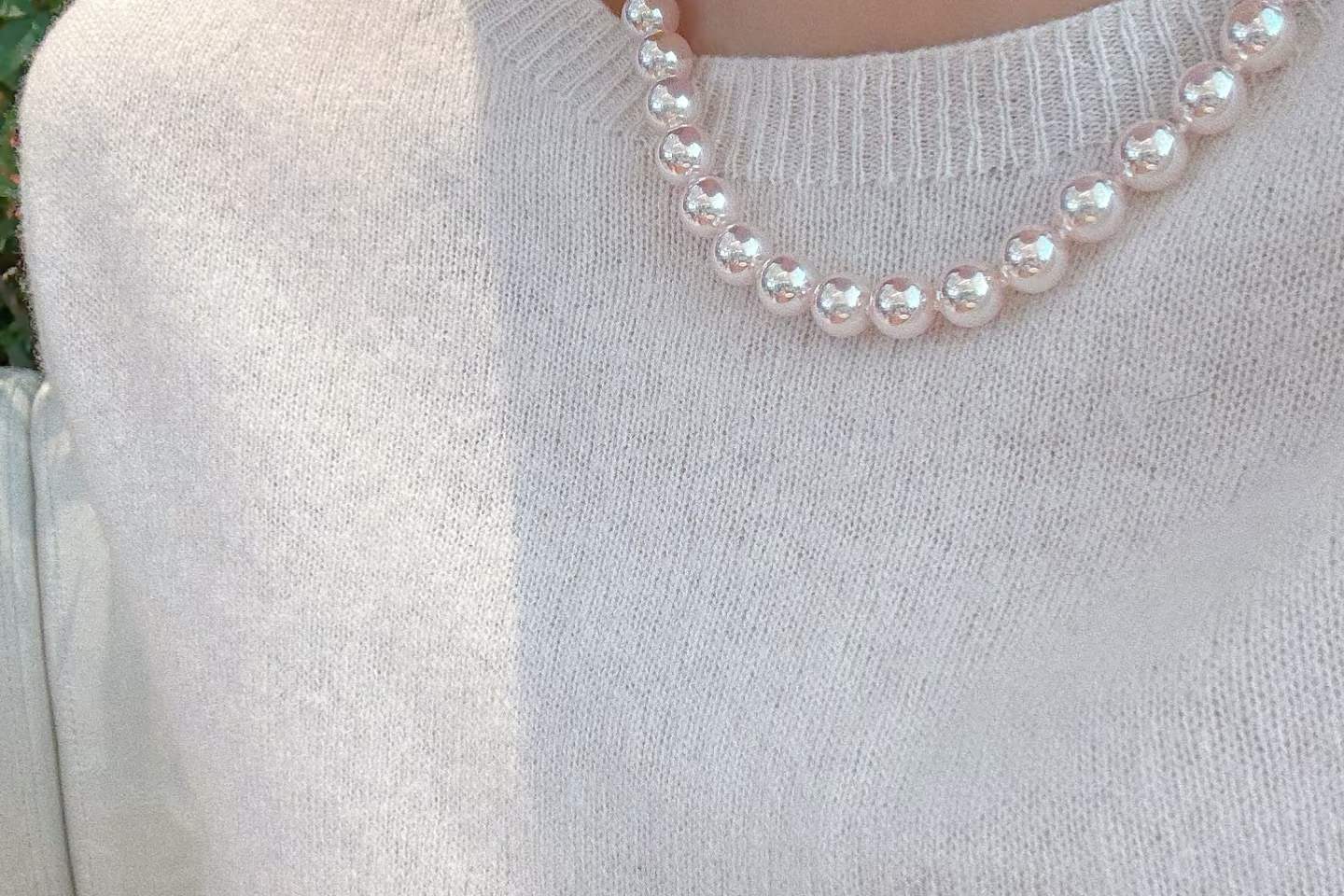
Pearls are the only gem material in fine jewelry that is produced by a living animal, and that single fact explains almost everything about how they are priced, how they wear and why the advice around them is so often wrong.
This guide covers the five types you will actually encounter, the factors that determine quality and price, how to tell what you are looking at, and the parts of the pearl trade that are less flattering than the marketing.
The five pearl types
Almost every pearl sold today belongs to one of five categories. Each has a distinct price band, a distinct size range and a distinct failure profile.
| Type |
Typical size |
Typical price, single pearl |
Price, 18-inch strand |
Notes |
| Akoya |
6–9mm |
15–120 USD |
400–2,500 USD |
Saltwater, Japan and China. High lustre, thin nacre |
| Freshwater |
5–12mm |
3–40 USD |
60–900 USD |
China. Rarely round in the natural state, often processed |
| South Sea |
9–20mm |
150–2,000 USD |
3,000–40,000 USD |
Australia, Indonesia, Philippines. Thick nacre, gold and white |
| Tahitian |
8–18mm |
80–1,200 USD |
1,500–20,000 USD |
French Polynesia. Dark body colours, thick nacre |
| Keshi |
4–12mm |
10–200 USD |
300–4,000 USD |
By-product, all nacre, no nucleus, irregular shapes |
Akoya
Akoya pearls come from the small saltwater oyster Pinctada fucata, farmed in Japan and increasingly in China. They are the classic round white pearl, and for most of the twentieth century they were the default image of what a pearl looks like.
Akoya lustre is typically the sharpest of any pearl type — a mirror-like reflectivity that South Sea and freshwater rarely match. The trade-off is nacre thickness. Akoya are nucleated with a relatively large bead, often 5 to 6mm, and the nacre layer deposited over it may be only 0.3 to 0.8mm thick. That is thin enough that the nucleus influences the final shape and colour, and thin enough that regular wear can abrade through to the bead.
Typical Akoya strands run 6 to 9mm and cost 400 to 2,500 USD for an 18-inch strand in 2026, with the top of the range reserved for certified Hanadama-grade material, which must have nacre at least 0.4mm thick and pass a specific lustre and surface assessment by the Pearl Science Laboratory in Japan.
Freshwater
Freshwater pearls come from Hyriopsis cumingii, farmed in enormous quantities in China's Zhejiang, Jiangsu and Anhui provinces. They are the least expensive pearls and the most variable in quality, and the range within the category is wider than the range between the other four types combined.
Historically, freshwater pearls were nucleated with a piece of mantle tissue rather than a bead, which meant they were nearly all nacre and had irregular, often elongated shapes. From around 2005, Chinese producers began using bead nucleation techniques, and round freshwater pearls with a bead nucleus became common. These are rounder and larger than the older material, but they have thinner nacre, and the bead can be visible in a poorly made strand.
Freshwater strands run from 60 USD for a low-grade 5mm strand to 900 USD or more for a fine 10mm round strand. The collapse in freshwater prices over the past twenty years is one of the more dramatic shifts in the gem trade: the same quality of strand that cost 300 USD in 2005 may cost 100 USD today.
South Sea
South Sea pearls come from Pinctada maxima, the largest pearl oyster, farmed in Australia, Indonesia, the Philippines and Myanmar. They are the most expensive pearls in regular commercial supply, and they are the ones with the thickest nacre — typically 2 to 4mm over a bead nucleus, sometimes more.
The thickness is the point. A South Sea pearl with 3mm of nacre is a solid object that can be worn daily for fifty years and still have nacre to spare. That durability, combined with the size — South Sea pearls are routinely 12 to 15mm and can exceed 20mm — is what the price buys.
White and gold are the two principal colours. Australian production is predominantly white and silver-white; Indonesian and Philippine production includes the deep golds that command the highest prices. An 18-inch strand of fine 12mm gold South Sea pearls runs 15,000 to 40,000 USD in 2026. A matched strand at 15mm can exceed 100,000 USD.
Tahitian
Tahitian pearls come from Pinctada margaritifera, farmed in French Polynesia. Despite the name, they are not from Tahiti itself — the farms are spread across the Tuamotu and Gambier archipelagos, and the pearls are traded through Papeete.
Tahitian pearls are prized for their dark body colours: green, blue, aubergine, grey and the highly sought peacock green. Nacre thickness is typically 1 to 3mm, good enough for decades of wear. Sizes run 8 to 18mm, with 10 to 12mm being the commercial centre of gravity.
Prices run 1,500 to 20,000 USD for an 18-inch strand, with peacock-green material at the top of the range and grey or brown at the bottom. A word of caution: many "Tahitian" pearls on the market are dyed freshwater or dyed Akoya. Dyed pearls often show colour concentration around the drill hole and in surface pits, which is where to look.
Keshi
Keshi pearls are a by-product of the culturing process. When an oyster rejects or partially rejects a nucleus, it sometimes deposits nacre around a fragment of tissue or shell instead, producing a pearl with no bead inside — all nacre.
Keshi are almost always irregular in shape: baroque, petal, cornflake, flame. Because they have no nucleus, they can have very thick nacre and excellent lustre. They are also, per gram, one of the better values in the pearl market, particularly in large sizes.
An 18-inch strand of large baroque keshi can run 300 to 4,000 USD depending on size, shape consistency and lustre. Matching a strand of keshi well is the hard part, and a well-matched strand costs a multiple of a poorly matched one of the same pearls.
Nacre thickness: the factor that outranks everything
If you take one thing from this guide, take this. Nacre thickness is the single most important quality factor in a pearl, and it is the one that sellers mention least often.
A cultured pearl is a bead nucleus surrounded by layers of nacre deposited by the oyster. The nacre is aragonite — crystalline calcium carbonate — laid down in thin sheets bound by conchiolin, a protein. The layered structure is what produces the interference colours and the deep, soft glow that distinguishes a pearl from a glass bead.
Nacre thickness determines four things:
Lustre depth. Light penetrates the nacre, reflects off deeper layers, and interferes with light reflecting off the surface. Thick nacre produces a lustre with depth — you can see into the pearl. Thin nacre produces a surface shine that looks metallic and shallow. The trade calls this "sharp" versus "deep," and it is visible within a second once you have compared them side by side.
Wear resistance. A pearl with 0.3mm of nacre has 0.3mm of material to lose before the bead shows. Pearls abrade against skin, clothing, each other and the knots. Under regular wear, thin-nacre Akoya can show nucleus at high points within a decade.
Colour richness. Body colour and overtone develop through the nacre layers. Thick nacre generally produces more saturated, more complex colour.
Value. Two pearls of the same diameter, same surface and same colour can differ by a factor of five on nacre thickness alone. This is why a 10mm Akoya strand might cost 900 USD and a 10mm South Sea strand might cost 8,000 USD — the South Sea pearl has several times the nacre.
How to assess it. Nacre thickness cannot be measured without X-ray, which is what the major laboratories do. In the hand, you assess it indirectly: hold the pearl under a lamp and look at how far the reflection penetrates. A thick-nacre pearl has a reflection with a visible depth to it. A thin-nacre pearl has a reflection that stops at the surface. Then compare a strand against another strand of similar size and colour. The difference is usually obvious within seconds, and it is the single most useful comparison you can make in a shop.
A note on prices
All prices are street prices observed in 2026 across US and EU retailers.
The seven value factors
The pearl trade assesses pearls on seven factors, conventionally in this order of importance. The ordering is contested — different dealers weight them differently — but this is a workable sequence.
| Factor |
What it means |
Weight in pricing |
| Nacre |
Thickness of the deposited layer |
Highest |
| Lustre |
Sharpness and depth of reflection |
Very high |
| Surface |
Freedom from blemishes, pits, bumps |
High |
| Shape |
Round, near-round, button, drop, baroque |
High |
| Colour |
Body colour plus overtone |
Moderate |
| Size |
Diameter in millimetres |
Moderate to high |
| Matching |
Consistency across a strand |
High in strands only |
Lustre is assessed by holding the pearl under a diffused light and looking at the clarity of the reflected image. The best pearls show a reflection sharp enough to read a printed page in, with an inner glow beneath it. Lustre is graded from excellent to poor, and it is the factor most quickly destroyed by poor care — perfume, hairspray and cosmetics dull lustre, and it cannot be restored.
Surface is graded by blemish count and visibility. The standard trade grading runs from flawless (no blemishes visible at 30cm) through minor, light, medium and heavily blemished. A useful check: examine the pearl from 30cm, which is how it will be seen when worn, not at 10cm under a loupe.
Shape runs from round through near-round, button (a flattened round), drop, oval, and baroque. Round is the most expensive because it is the rarest. Baroque pearls are the least expensive per pearl, and they have a distinct aesthetic that some buyers prefer — which makes baroque a genuine value category rather than simply a compromise.
Colour has three components: body colour, overtone, and orient. Body colour is the base hue. Overtone is the secondary colour visible in the reflection — a white pearl with pink overtone, or a Tahitian with green over grey. Orient is the iridescent rainbow play that appears on the finest pearls and is the hardest to fake.
Matching applies only to strands. Every pearl in a well-matched strand should be within a narrow tolerance of the others in size, shape, colour, lustre and surface. Matching is labour-intensive, and it is a large part of why a matched strand costs several times the sum of its individual pearls.
Natural, cultured and imitation
Three categories, and the terminology is genuinely confusing because of the way the word "natural" is used commercially.
Natural pearls form without any human intervention. A foreign object enters the oyster naturally, and the oyster deposits nacre around it. Natural pearls are extremely rare — a few thousand pearls a year reach the market globally, against hundreds of tonnes of cultured pearls. A natural pearl of any size is an auction object, and a natural strand is a museum piece. Prices for natural pearls run from several thousand dollars for a small single pearl to millions for a fine strand.
Cultured pearls form when a human inserts a nucleus into the oyster, and the oyster deposits nacre around it. This is the overwhelming majority of the pearl market — well over 99 percent by volume. Cultured pearls are real pearls: they are made of the same nacre, by the same animal, by the same biological process. The only thing the human provides is the irritant.
Imitation pearls are not pearls. They are glass, plastic, shell or ceramic beads coated with a lacquer that often contains ground fish scales to simulate lustre. They have no nacre and no value.
The terminology trap: in a retail shop, a strand described as "natural" almost always means "not imitation," not "formed without intervention." This is standard trade usage and it is not intended to deceive, but it does deceive. Ask explicitly: is this natural or cultured? A seller who knows the trade will answer without hesitation.
How to tell them apart
Four tests, in order of reliability.
The tooth test. Rub the pearl gently across the edge of your front tooth. Real nacre has a fine, sandy, slightly gritty feel, because the aragonite layers are microscopically uneven. Glass and plastic feel smooth and slick. This is the classic test, it works, and it is non-destructive. Do not bite down.
The loupe test. Look at the drill hole under a 10x loupe. A cultured pearl shows a cleanly drilled hole with nacre visible as a continuous layered edge. An imitation often shows a flaked or chipped edge where the coating has separated from the bead, and the coating is a distinct layer rather than a continuous structure.
The surface test. Real pearls have natural irregularities — tiny pits, bumps and variations. Imitation pearls are usually too smooth, and if they are textured, the texture repeats. Roll a strand across a flat surface: real pearls wobble slightly because no two are identical, imitation pearls roll evenly.
The weight and temperature test. Pearls are denser than plastic and less dense than glass, and they feel cool when first picked up and warm to skin temperature quickly. This is a weak test on its own but a useful confirmation.
A note on what I cannot verify: there is no test a consumer can perform that establishes nacre thickness, origin or treatment status. Those require laboratory analysis. Where a seller offers a report from a recognised laboratory — the Pearl Science Laboratory for Hanadama grading, GIA, or SSEF — that is verifiable information. Where a seller makes a claim without a report, treat it as unverified.
Strand lengths and which to choose
Pearl strands are sold at standard lengths, and each has a conventional name and a conventional use.
| Length |
Name |
Where it falls |
Suits |
| 14–16 in |
Collar / choker |
Base of the neck |
Formal, evening, high necklines |
| 18 in |
Princess |
Collarbone |
The default. Suits nearly everyone |
| 20–24 in |
Matinee |
Below the collarbone |
Daywear, over knitwear |
| 28–36 in |
Opera |
Mid-chest, can be doubled |
Formal daywear, layering |
| 40 in+ |
Rope / lariat |
Below the waist, can be tripled |
Statement, casual |
An 18-inch strand is the correct first purchase for almost everyone. It sits at the collarbone, works with both a crew neck and a shirt collar, and is the length that most pearls are cut and matched for.
Two practical notes. First, strand length is measured as the finished length including the clasp. A strand sold as 18 inches is 18 inches end to end. Second, longer strands require more pearls, so the price scales faster than linearly — a 36-inch strand needs twice the pearls of an 18-inch strand, but it also needs them matched across a longer run, which is harder. Expect a 36-inch strand to cost 2.2 to 2.5 times an 18-inch strand of the same pearls, not twice.
For a first strand, 18 inches in a 7 to 8mm pearl is the sweet spot. It is large enough to read as a pearl strand rather than a chain of beads, small enough to wear with a shirt collar, and priced at a level where quality is achievable. In freshwater that is 150 to 400 USD; in Akoya, 700 to 1,800 USD.
Knotting and why it matters
Pearls are strung on silk thread with a knot tied between each pearl. This is not decorative.
Protection. Without knots, pearls rub against each other with every movement, and nacre abrades. A knot holds each pearl away from its neighbours and absorbs movement. On a strand of 50 pearls worn weekly, an unknotted strand will show wear at the drill holes within a few years.
Loss prevention. If the thread breaks, knots mean you lose one pearl rather than the strand. On a fine South Sea strand, that is the difference between a 50 USD repair and a 15,000 USD loss.
Drape. Knotting gives a strand a slightly articulated quality that lets it lie flat against the neck rather than hanging as a stiff loop.
The material matters. Traditional silk is the standard: it is soft, it does not abrade nacre, and it has a slight stretch that allows the strand to move. The downside is that silk absorbs skin oils, cosmetics and moisture, and it degrades. Nylon and synthetic threads last longer but are harder and can cut into nacre over decades. Some modern restringers use a synthetic core wrapped with silk, which is a reasonable compromise.
Ask what thread is used. A restringer who uses silk and knots between every pearl is doing the job properly. One who uses monofilament without knots is not.
Restringing intervals
Restring every one to two years for a strand worn regularly, and every three years for occasional wear. The signals that a restring is due:
- The strand hangs with visible gaps between knots when held up.
- The thread is visible, fuzzy or discoloured between pearls.
- The strand has stretched — lay it flat and check whether it exceeds its nominal length.
- The clasp has become loose relative to the strand.
Restringing costs roughly 3 to 8 USD per inch, so an 18-inch strand runs 60 to 140 USD including a new clasp. On a 10,000 USD strand that is trivial maintenance. On a 100 USD freshwater strand it is not economical, and the honest advice is to wear it until it fails.
Care
The care guidance in how to clean jewelry applies, with pearl-specific additions.
Pearls go on last and come off first. Perfume, hairspray, cosmetics and sunscreen all contain solvents and acids that attack nacre and dull lustre, and the damage is permanent. Apply everything else, let it dry, then put on the pearls.
Wipe after every wear. A soft, dry or very slightly damp cloth, no soap, no ultrasonic, no steam. Ultrasonic cleaners destroy pearls. Soap leaves residue in the drill holes and in the knots, and residue in the knots accelerates thread degradation.
Never store pearls in a sealed plastic bag. Nacre needs some humidity. A sealed bag desiccates the pearls and the silk, and a dry silk thread is a brittle thread. Store in a soft pouch or a lined box, not in plastic.
Keep pearls away from hard stones. Diamonds and sapphires will scratch nacre. Store pearls separately, or in their own compartment.
Wear them. Pearls that sit in a box for years desiccate and lose lustre. Regular wear against skin keeps them in condition — the oils that damage silk thread are, in moderation, not harmful to nacre, and the humidity of wearing is beneficial. The tension between these two effects is why the restringing interval exists.
Where the pearl trade is unflattering
Three honest points.
Pearls do not hold value. This is the one that matters most and is least often stated. A fine South Sea strand may recover 40 to 60 percent of retail at auction, and that is the best case for a well-documented, high-quality piece. Akoya strands typically recover 20 to 40 percent. Freshwater strands recover very little, and in some cases nothing, because the secondary market is saturated. Buy pearls because you want to wear them, not because you think of them as an asset.
Freshwater prices have collapsed. Chinese freshwater production expanded enormously from the 1990s onward, and quality improved at the same time. The result is that a freshwater strand of a given quality costs a fraction of what it cost twenty years ago. If you own an older freshwater strand and have assumed it appreciated, it has almost certainly lost value. If you are buying, the low prices are genuinely good news — freshwater is the best value in the pearl market, and a 300 USD freshwater strand can be genuinely beautiful.
The word "natural" is used loosely. As covered above, in retail usage it usually means "not imitation." Genuine natural pearls are an auction category. Ask the question directly and listen to the answer.
A fourth point about what I cannot verify: I cannot assess the pearls in a photograph, and neither can anyone else. Nacre thickness, lustre and surface cannot be judged from an image, because images are lit, retouched and colour-corrected. If you are buying a strand above about 2,000 USD, buy in person or buy from a seller with a documented return policy. No photograph is a substitute for holding the strand under a lamp.
A note on prices
All prices are street prices observed in 2026 across US and EU retailers.
Frequently asked questions
How can I tell if pearls are real?
The most reliable simple test is the tooth test: rub a pearl gently against the edge of your front tooth. Real nacre feels slightly gritty or sandy because of its layered aragonite structure; glass, plastic and coated beads feel smooth. Also look for slight irregularities in shape and surface, and check the drill hole with a loupe — imitation pearls often show a flaked edge where the coating meets the hole.
What is the most important factor in pearl quality?
Nacre thickness. Everything else — lustre, surface, colour — is partly a function of it. A pearl with thick nacre has depth of lustre, resists wear for decades, and can be worn regularly. A thin-nacre pearl, common in cheap Akoya and some freshwater, looks dull from the start and can wear through to the bead nucleus within a few years of regular wear.
Are natural pearls better than cultured pearls?
Natural pearls are rarer and far more expensive, but rarity is not the same as quality. A fine cultured South Sea pearl can be more beautiful than a mediocre natural pearl. In a retail shop in 2026, a strand described as natural almost always means cultured, because a genuine natural strand of any size is an auction piece. Ask explicitly whether the pearl is natural or cultured.
How often should pearls be restrung?
Every one to two years for a strand worn regularly, and every three years for occasional wear. Silk stretches and absorbs skin oils, and the knots between pearls loosen over time. Restringing costs roughly 3 to 8 USD per inch of strand, so an 18-inch strand is typically 60 to 140 USD including a new clasp.
Do pearls hold their value?
Generally no. Pearls are a consumable luxury rather than a store of value. A fine South Sea strand may recover 40 to 60 percent of retail at auction, and Akoya and freshwater strands typically recover far less. Freshwater pearl prices have fallen substantially over the past two decades as Chinese production expanded, so older freshwater strands have lost value outright.
The bottom line
Buy one strand properly rather than three strands cheaply. An 18-inch strand of 7 to 8mm pearls with thick nacre, sharp lustre, clean surfaces and good matching is the piece you will wear for thirty years. In freshwater that costs 200 to 400 USD; in Akoya, 800 to 1,800 USD; in South Sea, 5,000 USD and up. Spend to the top of the band you can afford, because the difference between a mediocre pearl and a good one at the same size is entirely in the nacre, and nacre is the only part of a pearl that lasts.
Then maintain it. Restring every two years, wipe after every wear, put the pearls on last, and keep them away from perfume and hard stones. A well-cared-for strand outlives its owner. A neglected one dulls within a decade and cannot be brought back.