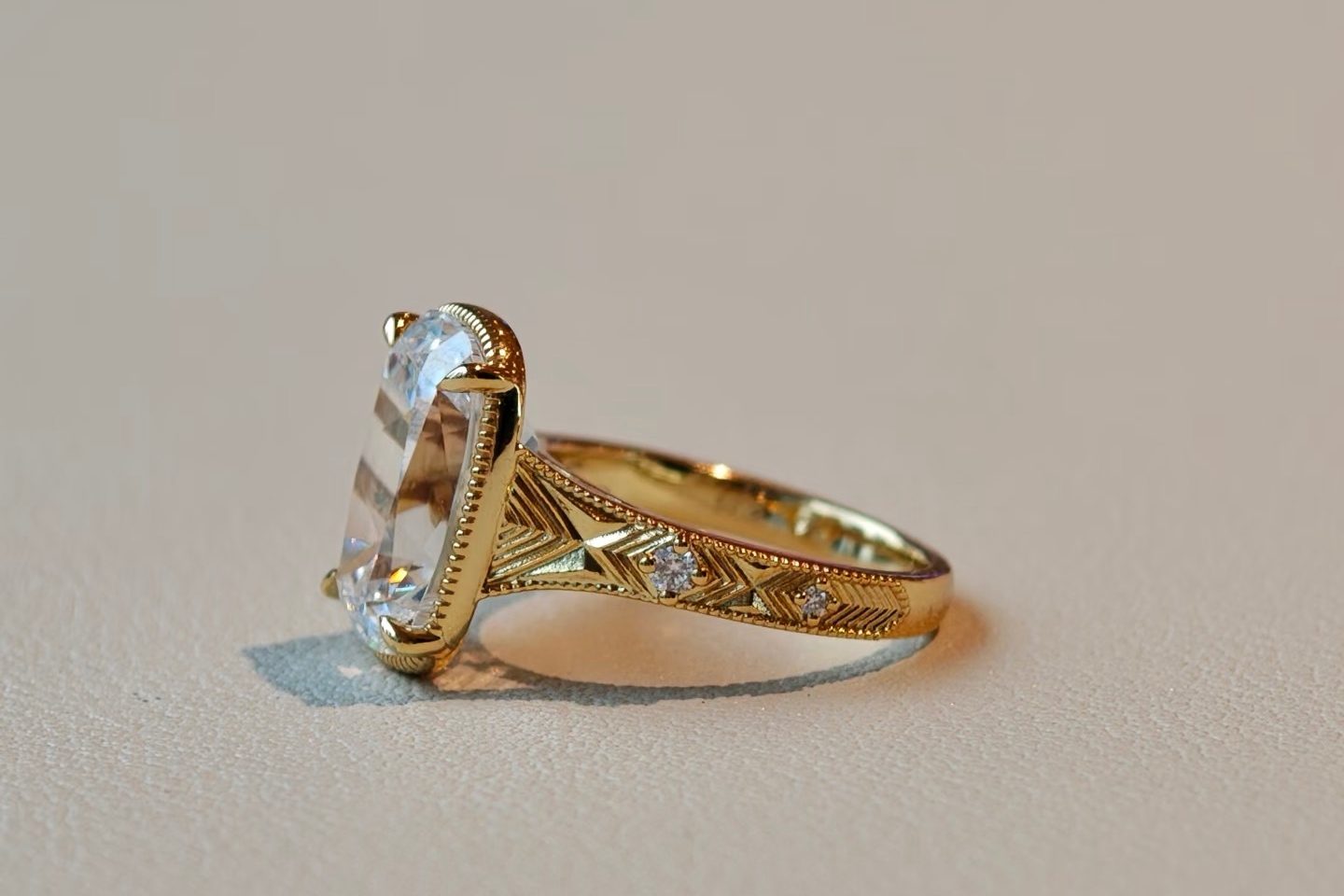
Most jewelry damage is not caused by accidents. It is caused by cleaning — by toothpaste, by ultrasonic machines, by jewellery dips and by the well-intentioned belief that a soft stone will survive the same treatment as a hard one.
This guide is the routine we use at the bench. It starts with the method that works for almost everything, then covers the exceptions, which are where the money is lost.
The method that works for almost everything
For gold, platinum, palladium, sterling silver, diamond, ruby, sapphire, spinel, alexandrite, garnet, citrine, amethyst and aquamarine:
- Fill a bowl with warm water — not hot, roughly hand temperature — and add one drop of mild dish soap. Not detergent, not hand soap, not dish soap with added moisturiser or antibacterial agents.
- Soak for five to ten minutes. This softens the residue. It does not do the cleaning.
- Brush with a soft-bristled brush. A baby toothbrush or a dedicated jewelry brush. Work the bristles into the underside of the setting, where the stone meets the metal. This is where the grime is, and it is why the stone looks dull even after cleaning.
- Rinse in clean warm water. Plug the drain, or use a fine strainer. Losing a stone down a sink is the most common jewelry accident there is.
- Dry with a lint-free cloth and leave to air for a few minutes before wearing. Water trapped in a setting will leave spots.
That is the whole method. It takes five minutes, costs nothing, and is what a jeweler does when you bring a ring in for a "professional cleaning" that costs $20.
What to brush, specifically
The underside of a diamond is where the problem is. A stone's brilliance depends on light entering through the crown and returning to your eye. Residue on the pavilion blocks that light from behind, which is why a diamond that looks grey and flat is usually just dirty rather than damaged. Brush the underside of the setting, not the top of the stone.
Yellow and rose gold
The safest of all. 10K, 14K and 18K gold are all inert and will not react with soap or water. Rose gold has an advantage in cleaning: because the colour comes from the alloy throughout rather than from a surface treatment, wear and cleaning cannot change its tone.
Avoid chlorine. Chlorine attacks the alloying metals in gold — particularly the copper and silver — and repeated exposure weakens the metal and can pit it. Take rings off before swimming in a pool or a hot tub. This is the single most damaging thing people routinely do to gold jewelry.
White gold
White gold is rhodium-plated, and the plating is what you are cleaning. Two rules follow.
Do not use abrasive polishes. Metal polish, polishing cloths impregnated with rouge, and toothpaste all remove the plating faster than normal wear. Use the soap method.
Expect replating. Every 12 to 24 months for a daily-wear ring, the plating wears through at the points of contact and the warmer alloy shows. Replating costs $30 to $80 and is a normal maintenance cost, not a defect.
If you want a permanently white metal, platinum or palladium is the answer. Neither requires plating.
Platinum
Platinum does not wear away in normal use — it displaces. The metal is pushed to the sides of a scratch rather than removed, which is why an old platinum ring keeps its weight and develops a matte patina.
Cleaning is the same soap method. If you prefer the original bright finish, a jeweler can polish it; be aware that polishing does remove a small amount of metal, and doing it frequently will eventually thin the surface. Many people prefer the patina.
Sterling silver
Silver tarnishes — it reacts with sulphur compounds in air to form silver sulphide, a black coating. Cleaning is therefore two separate jobs: removing tarnish, and removing grime.
For grime: the soap method.
For tarnish: a silver polishing cloth, used gently. For heavier tarnish, a jeweler's silver dip works, but only on plain silver with no stones — the chemicals damage pearls, opals and many coloured stones. A safer home method is a warm water bath with baking soda and aluminium foil, which reverses the tarnish chemically rather than abrading it.
Prevention: store silver in an airtight bag with anti-tarnish strips, and wear it. Silver worn regularly tarnishes far more slowly than silver stored, because the friction of wear removes the sulphide layer continuously.
Gold-plated and gold-filled
Handle these gently. Gold plating is measured in microns and will wear through with abrasive cleaning. Gold-filled has a much thicker bonded layer and lasts years, but the same rules apply: soap method only, no polishing compounds, no ultrasonic if the piece has stones set with adhesive.
Stones
This is where the damage happens. The hardness of a stone determines whether it can survive cleaning, and the wrong choice is irreversible.
Safe for everything, including ultrasonic
| Stone |
Mohs |
Notes |
| Diamond |
10 |
Safe in ultrasonic unless fracture-filled or laser-drilled |
| Ruby |
9 |
Safe unless lead-glass filled |
| Sapphire |
9 |
Safe unless diffusion-treated |
| Alexandrite |
8.5 |
Safe |
| Spinel |
7.5–8 |
Safe |
| Aquamarine |
7.5–8 |
Safe, but avoid steam |
Soap method only, no ultrasonic
| Stone |
Mohs |
Risk |
| Emerald |
7.5–8 |
Perfect cleavage plus routine oiling. Ultrasonic and steam can remove the oil filler and reveal fractures |
| Tourmaline |
7–7.5 |
Heavily included stones can fracture |
| Amethyst |
7 |
Generally fine, but chips at facet edges |
| Citrine |
7 |
Generally fine |
| Garnet |
6.5–7.5 |
Generally fine, but avoid thermal shock |
| Peridot |
6.5–7 |
Perfect cleavage, sensitive to thermal shock |
| Moonstone |
6–6.5 |
Perfect cleavage in two directions. Ultrasonic will crack it |
| Tanzanite |
6–7 |
Perfect cleavage, often fracture-filled |
Never use ultrasonic, steam, or chemical dips
| Stone |
Mohs |
Why |
| Opal |
5.5–6.5 |
Contains water. Heat and chemicals cause crazing — a permanent network of cracks |
| Turquoise |
5–6 |
Porous. Absorbs liquids and discolours. Stabilised turquoise can be ruined by solvents |
| Pearl |
2.5–4.5 |
Organic, porous, destroyed by acids, perfume, hairspray and ammonia |
| Lapis lazuli |
5–6 |
Porous, and often dyed. Solvents remove the dye |
| Amber |
2–2.5 |
Organic resin, soluble in alcohol and solvents |
| Coral |
3–4 |
Organic, porous, damaged by acids |
| Emerald (filled) |
— |
Ultrasonic can remove filler |
| Ruby (lead-glass filled) |
— |
Glass filler is damaged by acids and heat. Lemon juice will etch it |
| Any fracture-filled diamond |
— |
Ultrasonic can dislodge the filler and reveal the drill channels |
For everything in the third table, use a dry soft cloth only, or at most a barely damp cloth with plain water, dried immediately. Pearls should be wiped with a soft cloth after each wear — before they are put away, not the next morning — because skin oils and perfume are what dull them.
Products to avoid
Toothpaste. Contains silica and calcium carbonate, both harder than the metals in jewelry. It scratches gold, strips rhodium plating, and dulls softer stones. This is the most common cause of preventable damage we see at the bench.
Jewelry dips and liquid cleaners. These are acid-based and work by dissolving surface metal. They are acceptable for heavily tarnished plain silver and for nothing else. They damage pearls, opals, turquoise, and any stone with a filled fracture.
Household ammonia. Effective on diamond and gold, damaging to everything porous and to rhodium plating. If you use it, dilute it heavily and use it only on plain diamond-and-gold pieces.
Vinegar and baking soda on stones. Fine on plain silver. On stones, the acidity can damage porous material and filled fractures.
Ultrasonic machines on anything from the third table above. An ultrasonic cleaner is a genuinely useful tool and we use one daily. It is also the fastest way to destroy an opal.
Boiling water. Thermal shock cracks stones. Emerald, opal, peridot and moonstone are all vulnerable.
Storage
Storage causes more damage than cleaning, because it works continuously.
The principle: hard stones scratch soft ones, and metal scratches everything. Store pieces so they do not touch.
- Rings and earrings: a compartmented box or a tray with individual slots. Never a shared pouch.
- Chains: hung individually on hooks, or each in its own soft bag. This also prevents tangling.
- Pearls: a soft pouch, away from metal. Pearls are the softest thing in most jewelry boxes and will lose their nacre to a diamond.
- Silver: airtight bags with anti-tarnish strips, in a dry place.
- Everything: away from direct sunlight, which fades amethyst and can craze opal, and away from radiators and windowsills, where temperature swings cause damage.
One more thing: check prongs before storage, not after. Run a fingernail along the top of each prong and feel for a snag. A prong that catches is a prong that is wearing thin, and tightening it costs $20 while replacing a lost stone costs hundreds.
What to leave to a jeweler
Some jobs should not be done at home.
Ultrasonic cleaning of heavily soiled pieces with inaccessible settings — a jeweler's ultrasonic is more powerful and they can inspect afterwards.
Prong retipping and tightening. This requires a torch and a steady hand. Do not attempt it.
Rhodium replating. An electroplating process, $30 to $80, done in a few days.
Removing heavy tarnish from silver with fine detail. A jeweler can do this without wearing away the pattern.
Anything where a stone feels loose. Stop wearing it immediately and take it in. A loose stone is a stone that is about to become lost.
A schedule that works
| Frequency |
Task |
| After every wear |
Wipe pearls and silver with a soft dry cloth before storing |
| Weekly |
Soap-and-brush clean rings worn daily |
| Monthly |
Clean necklaces, earrings and bracelets |
| Every 3 months |
Inspect all prongs and clasps with a loupe or a fingernail |
| Every 6 months |
Check chain links for stretching; check that clasps still hold securely |
| Every 12–24 months |
Replate white gold; professional cleaning and inspection |
| Every 2–3 years |
Restring pearl strands; re-appraise for insurance |
A small kit covers almost everything, and it costs less than a single professional cleaning.
| Tool |
Cost |
What it is for |
| Soft-bristled jewelry brush |
$5–$12 |
The workhorse. Fine bristles reach under settings |
| Baby toothbrush |
$2 |
A perfectly good substitute; softer than most jewelry brushes |
| Lint-free polishing cloth |
$8–$15 |
Drying and light polishing. Two — one for silver, one for everything else |
| Silver polishing cloth (impregnated) |
$10–$20 |
Tarnish removal on plain silver only |
| 10× jeweler's loupe |
$15–$40 |
Prong inspection. The single most useful item here |
| Plastic fine-tooth strainer |
$3 |
So you do not lose a stone down the drain |
| Small ultrasonic cleaner |
$40–$120 |
Genuinely useful — for the stones in the safe list only |
| Anti-tarnish strips |
$8 |
For silver storage |
| Soft drawstring pouches |
$1 each |
Individual storage, which prevents most scratching |
The loupe deserves a note. Prong wear is the leading cause of lost stones, and it is invisible without magnification. Running a fingernail along each prong will catch a snag, but a loupe shows you the thickness. Five minutes with a loupe every three months will save more money than any other habit in this guide.
If you buy an ultrasonic cleaner, buy one with a removable basket and a heating function, and read the safe-stone tables above before using it. A $60 ultrasonic machine used on an opal causes several hundred dollars of damage.
When jewelry is beyond home care
Some problems are not cleaning problems, and trying to fix them at home makes them worse.
A loose stone. If a stone moves when you press it gently with a fingernail, stop wearing the piece immediately. Do not clean it — the brushing action can dislodge it entirely. A jeweler can tighten a prong for $15 to $30. Replacing a lost 1-carat stone costs hundreds.
A bent or worn prong. Prongs thin over years of wear. Retipping — building up the metal with a torch — requires skill and the right alloy. This is not a home repair.
Deep scratches in gold or platinum. Polishing removes metal, and polishing a deep scratch by hand will flatten the surrounding surface rather than restore it. A jeweler can polish and refinish properly with a buffing wheel.
A stretched chain. Gold chains stretch over time, particularly fine ones worn with pendants. A stretched link cannot be tightened at home; the link needs to be closed or the section replaced. Continuing to wear it will eventually break it.
Worn rhodium plating. Replating is electroplating and requires equipment. It is inexpensive at a jeweler, and there is no home equivalent that works.
Cloudy or discoloured stones. A stone that looks cloudy after cleaning may be oiled (emerald), fracture-filled (diamond, ruby) or crazed (opal). Each of these is a specific problem with a specific remedy, and cleaning will not fix any of them.
Anything with sentimental value and structural damage. Take it in. The cost of an inspection is trivial next to the cost of losing an heirloom.
Care by piece type
Different pieces fail in different ways, and the maintenance schedule should reflect that.
Engagement rings. Clean weekly. Inspect prongs monthly. Check the solder joints at the base of the head — this is where cathedral and peg-head settings fail. Expect a professional inspection annually.
Wedding bands. Plain bands need almost nothing; a monthly clean is generous. Diamond-set bands need the same prong attention as an engagement ring, and eternity bands need the setting checked every six months because there is no plain metal to absorb wear.
Necklaces and chains. Clean monthly. Check links for stretching by holding the chain at both ends and looking for elongated links. Check the clasp — a worn lobster claw is a necklace on the floor. Replacing a clasp costs $20; replacing the chain costs considerably more.
Earrings. Clean monthly, and pay attention to the posts and backs. Post joints are a common failure point, and an earring that falls out is usually lost permanently. Earring backs should grip firmly; if a back slides off easily, replace it.
Bracelets. The most damage-prone category, because they contact everything. Clean monthly, inspect the clasp every three months, and check any stone settings on the underside of the wrist, where impact is most likely.
Pearls. Wipe with a soft dry cloth after every wear, before storage. Never wet, never sprayed, never stored against metal. Restring every two to three years if worn regularly, and always restring if the silk is stretched or discoloured — the knots between pearls are what stop a broken strand from scattering across a room.
Quick reference
If you remember nothing else from this guide, remember this table.
| Stone or metal |
Soap and brush |
Ultrasonic |
Chemical dip |
| Diamond, ruby, sapphire |
Yes |
Yes |
Yes, diluted |
| Gold, platinum, palladium |
Yes |
Yes, if no soft stones |
Only if plain metal |
| Sterling silver |
Yes |
Yes |
Yes, if plain metal |
| White gold (plated) |
Yes |
Yes |
No — strips plating |
| Emerald, tourmaline, tanzanite |
Yes |
No |
No |
| Amethyst, citrine, garnet, peridot |
Yes |
No |
No |
| Moonstone, opal, turquoise |
No — dry cloth |
No |
No |
| Pearl, coral, amber, lapis |
No — dry cloth |
No |
No |
| Any filled or treated stone |
Yes, gently |
No |
No |
The pattern is simple: hardness and treatment determine the method, and anything organic, porous or fracture-filled should never see water, vibration or chemicals. When in doubt, use a dry soft cloth. It is never the wrong answer.
Frequently asked questions
What is the safest way to clean jewelry at home?
Warm water with a drop of mild dish soap, a soft-bristled brush, and a lint-free cloth to dry. This is safe for gold, platinum, palladium, sterling silver, diamond, ruby, sapphire and most durable stones. It is the method we use at the bench for routine cleaning, and it costs nothing.
Can I use an ultrasonic cleaner on all my jewelry?
No. Ultrasonic cleaners should never be used on emerald, opal, pearl, turquoise, lapis, moonstone, tanzanite, amber, coral, or any fracture-filled or lead-glass-filled stone. The vibration can fracture stones with existing inclusions or drive cleaning fluid into filled fractures, discolouring them permanently.
Does toothpaste clean jewelry?
No, and it damages it. Toothpaste contains abrasives — silica, calcium carbonate — that are harder than the soft metals used in jewelry. It scratches gold, removes rhodium plating, and dulls the surface of softer stones. It is the single most common cause of preventable damage we see.
How often should I clean my jewelry?
Rings worn daily should be cleaned weekly, because skin oils and soap residue accumulate in the setting and dull the stone from underneath. Necklaces and earrings monthly is sufficient. Sterling silver needs polishing every few weeks because it tarnishes from atmospheric sulphur.
Why does my white gold ring look yellow after a while?
Because the rhodium plating has worn through and the underlying alloy — which is warmer in tone — is showing. This is normal after 12 to 24 months of daily wear and is fixed by replating, which costs $30 to $80 and takes a few days.
The bottom line
Learn one method — warm water, a drop of soap, a soft brush, dry thoroughly — and use it weekly on anything durable. Learn the exceptions in the tables above, and apply them strictly, because the damage from getting it wrong is permanent.
Then put the toothpaste down. It is the most expensive free cleaning product in existence, and it has cost more people more money than any other household item in the jewelry box.