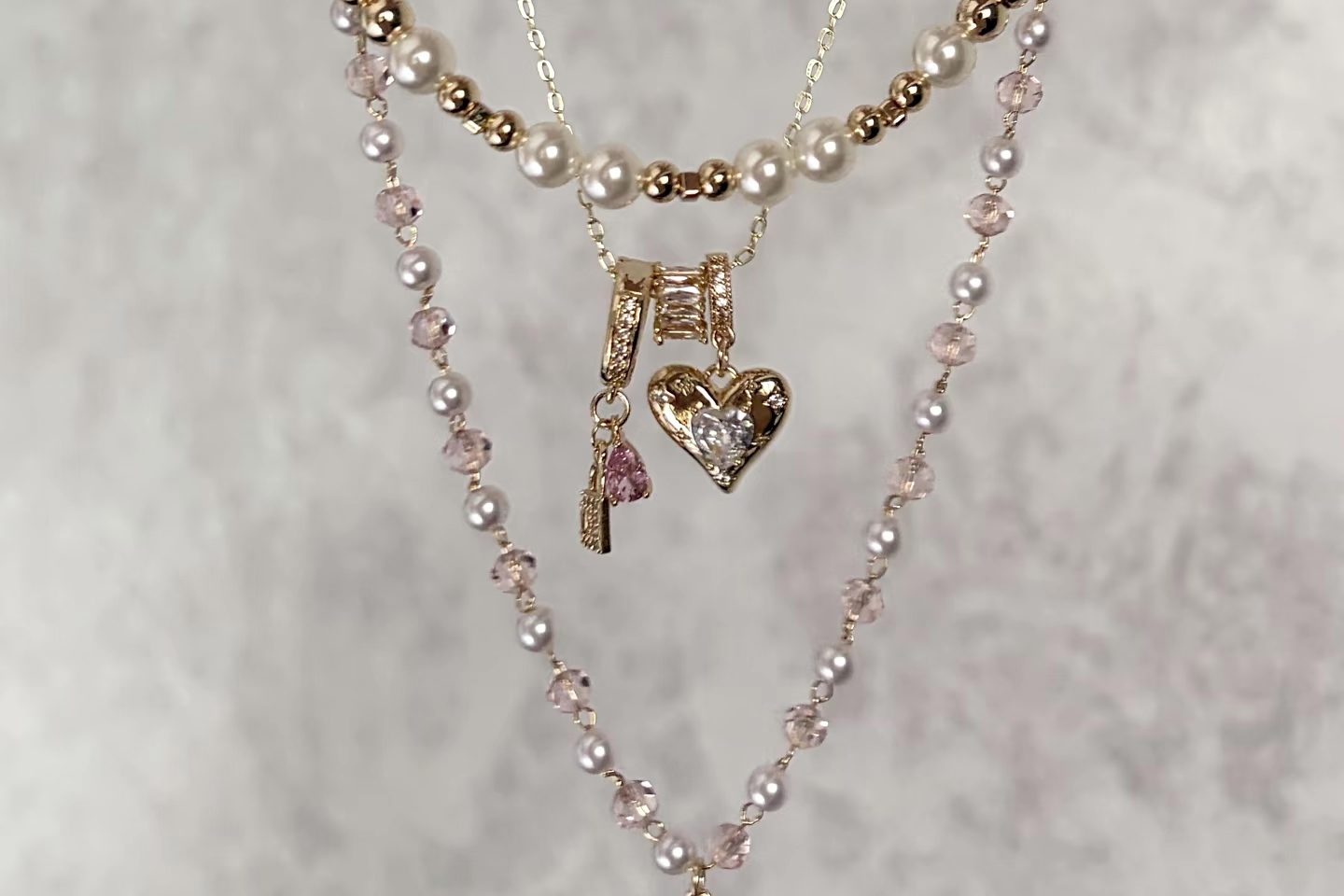
A pendant is two objects sold as one: the pendant itself and the chain that carries it. Almost every disappointing pendant purchase is a failure of the second object. The pendant is what you chose; the chain is what decides whether it hangs correctly, sits flat, stays centred, and survives being worn.
This guide covers the chain length, the bail, the weight ratio and the failure points — the four things that determine whether a pendant works.
Matching pendant size to chain and to frame
Pendant size is measured across its widest point, excluding the bail. The relationship between pendant size and the person wearing it is less about height and more about shoulder width and neck length, but the useful ranges are narrow enough to state plainly.
| Pendant width |
Reads as |
Chain it needs |
Best drop length |
| Under 8mm |
Delicate, almost a dot |
0.8–1.0mm cable or box |
16–18 in |
| 8–12mm |
Small, everyday |
1.0–1.2mm cable |
16–18 in |
| 12–18mm |
The versatile middle |
1.2–1.5mm cable or curb |
18 in |
| 18–25mm |
A focal piece |
1.5–2.0mm curb or rope |
18–20 in |
| 25–35mm |
Statement |
2.0–2.5mm curb or paperclip |
20–24 in |
| 35mm+ |
Sculptural, costume-adjacent |
2.5mm+ or a cord |
24–30 in |
The single most common mistake is buying a pendant at the top of a size band and pairing it with a chain at the bottom of the matching band. A 22mm disc on a 1.0mm cable chain will look under-supported, will hang at an angle, and will eventually stretch the chain. When in doubt, go one chain weight heavier than the table suggests.
Body frame matters at the margins. On a narrow frame, a large pendant occupies proportionally more of the chest and reads as bigger than it measures. On a broader frame, the same pendant reads smaller. There is no formula for this — the table gives you the range, and trying it on gives you the answer.
The bail: the most overlooked component
The bail is the loop at the top of the pendant through which the chain passes. It determines three things: whether the pendant sits flat, whether it can rotate, and whether it will be lost.
Fixed bail (soldered or cast)
The bail is part of the pendant, cast or soldered in place, and the chain threads through it. The pendant hangs in a fixed orientation and cannot twist relative to the chain. This is the most secure arrangement — there is no open ring to stretch — and it is the standard on higher-end pendants.
The limitation is that a fixed bail commits the pendant to one plane. If the pendant is asymmetric, it will hang at whatever angle the bail was designed for, and that angle is fixed. Fixed bails also make it harder to swap the pendant between chains, because the chain must be threaded rather than clipped.
Jump ring bail
A separate open ring, threaded through a hole in the top of the pendant and then closed. This is the cheapest bail to manufacture and by far the most common at mid-market.
The advantage is that the pendant can rotate freely, so it always settles flat against the chest regardless of how the chain twists. That is why jump-ring pendants so often look better in motion than fixed-bail ones.
The disadvantage is decisive: the jump ring is an open ring under load, and it is the single most common point of loss. A jump ring that has been closed but not soldered will open under repeated lateral load — exactly the load a pendant experiences when it swings. If a pendant you own uses a jump ring bail, have a jeweler solder it closed. The cost is 15 to 40 USD and it removes the failure entirely.
Hidden bail
The chain passes through a channel inside the pendant body, so no bail is visible. This is the cleanest look and is common on flat pendants such as discs, bars and tags. The trade-off is that the internal channel must be wide enough for the chain, and a hidden bail only works with chains up to a certain gauge. A hidden bail designed for a 1.2mm chain will not accept a 2mm curb.
Hidden bails also wear from the inside, where you cannot see the wear. Inspect them by running the chain through by hand and feeling for roughness.
Slider bail
A bail with an internal silicone or rubber grip that slides along the chain and holds position. Slider bails let you adjust the drop length without changing chains, which is genuinely useful.
They have two problems. The grip degrades — silicone compresses and loses friction over one to three years, and once it does, the pendant slides down to the lowest point of the chain and stays there. And the grip can deposit residue on the chain. Slider bails are a good short-term solution and a poor long-term one.
| Bail type |
Sits flat |
Can rotate |
Security |
Best for |
| Fixed |
Yes |
No |
Highest |
Symmetric pendants, high-value pieces |
| Jump ring |
Yes |
Yes |
Lowest unless soldered |
Mid-market, swap-friendly |
| Hidden |
Yes |
No |
High |
Flat pendants, clean look |
| Slider |
Yes |
Yes |
Moderate |
Adjustable length, casual pieces |
| Enhancer clip |
Yes |
Yes |
High |
Interchangeable pendants on a chain |
A fifth option, the enhancer clip, is a spring-loaded clasp that clips onto a chain at any point. It is the best solution for someone who wants to move one pendant between several chains, and it distributes load well. Enhancer clips add visible bulk at the top of the pendant, which is why they are more common on heirloom pieces than on minimal ones.
Chain length and where each length falls
Chain length is measured in inches in the US and centimetres in Europe, end to end including the clasp. The named lengths are the useful vocabulary.
| Length |
Name |
Where it falls |
Suits |
| 14 in |
Collar |
Base of the neck, above the collarbone |
Very small pendants, deliberate tight look |
| 16 in |
Choker |
Base of the throat |
Small pendants under 12mm |
| 18 in |
Princess |
Collarbone |
The default for nearly everything |
| 20 in |
Matinee |
Just below the collarbone |
Pendants over 20mm |
| 24 in |
Opera |
Mid-chest |
Large pendants, layered looks |
| 30 in |
Rope |
Below the bust |
Statement pendants, doubling |
| 36 in+ |
Lariat |
Waist when doubled |
Long chains, intentional layering |
Two practical notes that the chart cannot capture. First, these positions shift with body size — an 18-inch chain on a tall person with a long neck may fall at the throat rather than the collarbone, and a 16-inch chain on someone with a broader neck may not close comfortably at all. Second, an 18-inch chain with a 25mm pendant does not fall at the collarbone; the pendant's own height adds to the drop, so the bottom of the pendant may sit two inches lower than the chain's nominal position.
That second point is why the honest advice is to measure. Put on a chain you already own at a length you like, note where the bottom of the pendant falls, and buy the new pendant to that same bottom point rather than to the same chain length.
The weight ratio: why a heavy pendant on a fine chain fails
This is the technical heart of pendant selection, and it is almost never explained at the point of sale.
A chain has a working load, and a pendant applies a static load plus a dynamic load every time you move. The static load is the pendant's weight. The dynamic load depends on how much the pendant swings — a 5-gram pendant on a 24-inch chain swinging through a 30-degree arc can briefly apply three or four times its weight in tension.
Three failure modes follow.
Chain stretch. A fine cable chain is made of links drawn from wire and soldered or formed closed. Under repeated load above its design range, the links open slightly and the chain elongates permanently. A stretched chain cannot be repaired; it must be replaced. This is why a chain that "grew" an inch over two years is a chain that was overloaded.
Bail wear. The pendant's bail bears against the chain at a single point, and every swing is a small abrasion. On a thin chain under a heavy pendant, the bail cuts into the chain's links. Over a few years you can see a flattened, polished spot on the links where the bail sits. Once that spot is deep enough, the link is thinner there and becomes the chain's weakest point.
Clasp failure. The clasp carries the full load of the entire assembly, and the spring in a lobster claw is the smallest mechanism in the piece. A loaded clasp held under continuous tension will fatigue its spring. When it opens, you lose the chain and the pendant together.
| Pendant weight |
Minimum chain gauge, 14K |
Recommended link style |
| Under 1g |
0.8mm |
Cable or box |
| 1–2g |
1.0mm |
Cable or box |
| 2–5g |
1.2–1.5mm |
Cable, curb or rope |
| 5–10g |
1.5–2.0mm |
Curb, rope or paperclip |
| 10–20g |
2.0–2.5mm |
Curb, paperclip or heavy box |
| Over 20g |
2.5mm+ or cord |
Heavy curb, snake or leather cord |
A working rule that is easier to remember: the chain should look like it could hold the pendant if the pendant were ten times heavier. If a chain looks delicate under a pendant, it is.
A note on prices
All prices are street prices observed in 2026 across US and EU retailers.
Stone-set, plain and engraved pendants
The three constructions behave differently and are bought for different reasons.
Plain metal pendants. A solid shape — a disc, a bar, a tag, a signet. These are the most durable pendants and the easiest to maintain, because there is nothing to catch and nothing to lose. A plain 14K disc at 15mm weighs around 1.5 to 2.5 grams depending on thickness and costs roughly 150 to 400 USD. Polish it with a cloth and it lasts indefinitely.
Stone-set pendants. A single stone in a bezel or prong setting, or a cluster. The bezel setting is the more practical choice for a pendant because it has no prongs to catch on clothing and no prongs to bend. A bezel-set 4mm stone pendant in 14K runs about 250 to 700 USD for a natural diamond, or 120 to 350 USD for a lab-grown one of the same size. Prong-set pendants are more brilliant but they snag, and a snagged prong on a pendant is more likely to bend than on a ring because the pendant is unconstrained.
Engraved pendants. A plain pendant with text or a pattern cut into the surface. The durability question is the depth of the engraving. A shallow laser engraving on a 0.5mm-thick disc is essentially cosmetic and can polish out over years of wear. A hand-engraved cut 0.3mm deep into a 1.5mm-thick blank will outlast the owner. Ask for the metal thickness of the blank and the engraving depth in millimetres; a maker who can answer is a maker who thought about it.
Choosing a pendant for someone else
Pendants are the most-gifted and most-often-wrong piece of jewelry, because the recipient's constraints are invisible to the buyer. Four rules that reduce the error rate.
Buy the chain length first. Length determines wearability, and wearability determines whether the gift gets worn. An 18-inch chain fits nearly everyone and falls at the collarbone. If you know nothing else, buy 18 inches.
Avoid personal content unless you are certain. Initials, birthstones, names and dates are high-risk. A birthstone you have guessed wrong is a permanent reminder of the guess. If you want a personal element, ask.
Match the recipient's existing metal. Look at what they already wear. If everything is yellow gold, a white gold pendant will sit in a drawer even if it is beautiful. This is the most common reason gifted pendants go unworn.
Keep the pendant between 12mm and 20mm. This band reads as a considered gift at every age and suits nearly every frame. Below 10mm it can read as an afterthought; above 25mm it is a statement the recipient may not want to make.
One more: check whether the recipient wears pendants at all. Some people find them distracting and never wear them, and no amount of correct sizing fixes that.
The layering interaction
If the pendant will be worn with other necklaces, the pendant's role in the stack has to be planned. This is covered in full in how to layer necklaces, but three pendant-specific points are worth stating here.
A pendant on the shortest chain of a stack will sit at the top of the arrangement and will draw the eye first. That is usually wrong — the heaviest visual element belongs at the bottom of the stack, so the eye travels down. Put the plainest chain on top and the pendant lowest.
A pendant on a middle layer will collide with the chain below it, because the pendant hangs lower than its chain's nominal length. If a 20-inch chain carries a 25mm pendant and a 24-inch chain sits below it, the pendant's bottom edge may reach the 24-inch chain's plane and the two will tangle. Leave at least four inches between a pendant's bottom edge and the next chain.
Two pendants on the same stack need a two-inch minimum length difference and different bail types, so that they cannot interlock. Two jump-ring pendants on adjacent chains will find each other.
Wear and failure points
Four things to inspect, in order of how often they cause loss.
The bail and its ring. As covered, an unsoldered jump ring is the top cause of pendant loss. Have it soldered.
The chain at the bail contact point. Check for a flattened or polished spot on the links where the bail sits. If you can feel a thin spot with a fingernail, replace the chain before it breaks.
Chain stretch. Lay the chain flat and straight on a table and measure it. Compare to its nominal length. More than a quarter inch of growth on an 18-inch chain means the links have opened and the chain is compromised.
The clasp. Test it weekly by closing it and pulling firmly. A lobster claw whose spring has weakened will open under light tension. Clasp replacement is 25 to 70 USD and is far cheaper than replacing the chain and pendant.
Cleaning matters here too, and the guidance in how to clean jewelry applies — but note that a pendant on a chain traps soap and skin residue in the bail channel, and that residue abrades the chain. Rinse pendants thoroughly after any cleaning, and pay attention to the bail, not just the pendant body.
Where this advice is wrong
Three honest limits.
First, the weight-ratio table is conservative. Many people wear a 3-gram pendant on a 1.0mm chain for years without a problem, because their pendant does not swing much and the chain is well made. The table describes where failure becomes likely, not where it becomes certain, and a well-made 1.0mm box chain will outperform a poorly made 1.5mm cable.
Second, the anti-jump-ring advice assumes the pendant will be worn under load and in motion. A pendant worn occasionally, on a chain that stays tucked under a shirt, is at far lower risk. The soldering recommendation is cheap enough that I would still do it, but it is not urgent for everyone.
Third, I cannot tell you what pendant suits you. Everything here is about whether a pendant will function. Whether a 20mm gold disc is right for your wardrobe is a question about your taste, and no specification answers it.
Frequently asked questions
What length chain is best for a pendant?
An 18-inch chain is the default and falls at the collarbone, which suits most pendants under 20mm. A 16-inch chain sits at the base of the throat and suits small, light pendants only. A 20-inch chain falls just below the collarbone and is the best choice for pendants over 20mm.
What is the difference between a fixed bail and a jump ring bail?
A fixed bail is soldered or cast into the pendant, so the pendant hangs in a permanently correct orientation and cannot twist. A jump ring bail is a separate open ring threaded through a hole in the pendant, which allows the pendant to rotate and sit flat against the chest. Jump rings are also the weakest point and the usual place a pendant is lost.
How heavy a pendant can a fine chain carry?
As a working rule, the chain should be at least as strong as the pendant is heavy. A 1mm cable chain in 14K safely carries up to about 2 grams. For a 5-gram pendant, use a chain of at least 1.5mm; for a 10-gram pendant, 2mm or heavier, or a chain with a stronger link style such as a box or curb.
Why does my pendant always end up off-centre?
Because the chain has a clasp, and the clasp is denser than the chain, so it drifts to the lowest point — the front of the neck. The pendant follows the chain's balance point. A slider bail, a heavier chain, or fastening so the clasp sits at the back and using a small spacer largely solves it.
How do I choose a pendant as a gift?
Choose the chain length first and the pendant second, because length is the thing that determines whether the gift is wearable. An 18-inch chain suits nearly everyone. Avoid initials, birthstones you have not confirmed, and religious or symbolic designs unless you are certain of the recipient's preference.
The bottom line
Buy the chain and the pendant as a single decision, and let the chain lead. A 1.2mm to 1.5mm 14K curb or box chain at 18 inches, with a soldered bail on a pendant between 12mm and 20mm, is the combination that works for the most people in the most situations. Budget 180 to 350 USD for the chain and 150 to 500 USD for the pendant, and spend the extra 20 USD to have the bail soldered closed.
If you already own a pendant that sits off-centre, hangs at an angle or slides down to the clasp, the problem is almost never the pendant. It is the chain's weight, the bail's type, or a jump ring that has opened. Fix those three things before you buy a replacement.