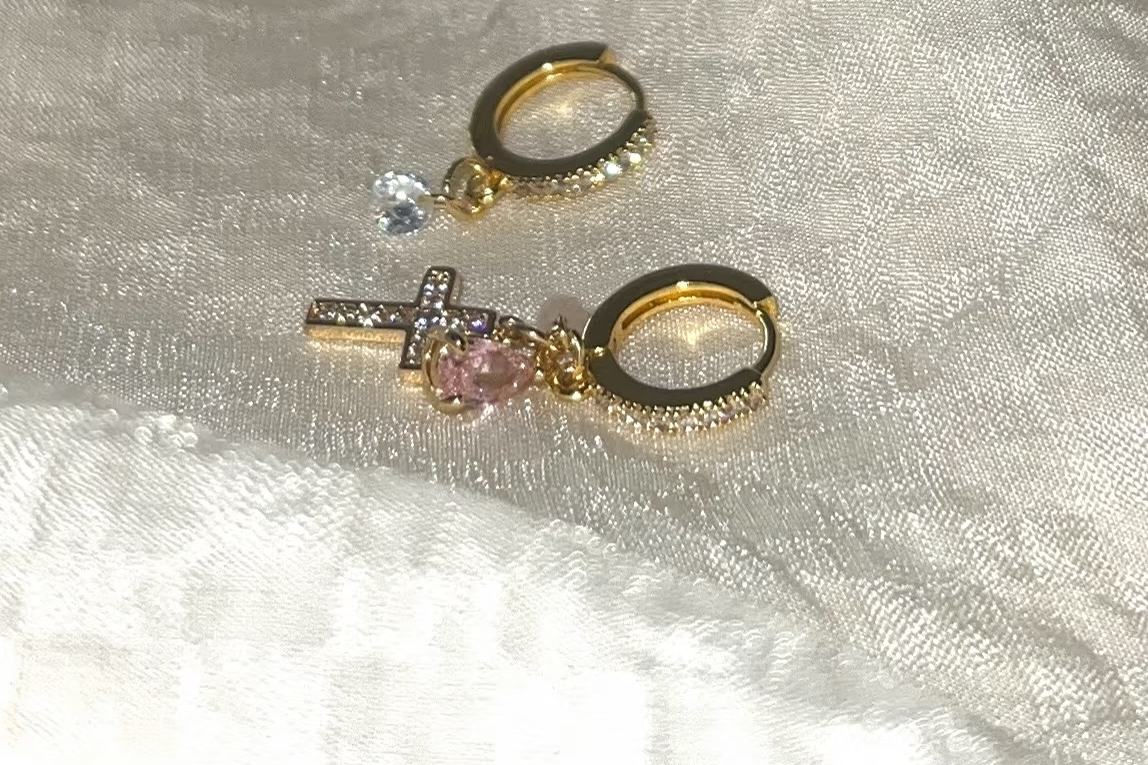
Gold hoops are the most-bought and least-understood piece of jewelry in the category. Almost everyone owns a pair. Almost nobody can tell you the diameter, the tube gauge, the wall thickness or the closure type of the pair they own, and those four numbers determine whether the earrings still look right after two years of wear or end up bent in a drawer.
This guide is about those four numbers. It is written from the perspective of someone who bought hoops for a multi-brand retailer and had to process the returns.
Why hoops are the hardest earring to buy well
A stud earring is a simple object. The failure modes are few: the post bends, the backing falls off, the stone chips. A hoop is a small mechanical assembly. It has a curved body, a hinge, a post, a catch, and — in hollow versions — an internal void. Every one of those parts can fail independently, and the failure is usually invisible at the point of sale.
The other complication is that hoops are sold by appearance rather than by specification. A product page will tell you the diameter and the gold karat and nothing else. It will not tell you the wall thickness of the tubing, which is the number that decides whether the hoop dents when you put a handbag strap over your shoulder. It will not tell you the post gauge, which decides whether the hoop droops forward. It will not tell you whether the hinge is a machined barrel hinge or a stamped tab.
You can infer most of this from weight. A pair of 25mm solid 14K hoops should weigh roughly 2.5 to 4 grams for the pair at a 1.5mm tube, and 5 to 8 grams at a 2.5mm tube. If a retailer lists a 25mm pair at 0.9 grams and calls it solid gold, the description is wrong. Weight is the honest number, and it is the one number you can check with a kitchen scale when the earrings arrive.
Diameter: what each size actually looks like
Hoop diameter is measured across the widest interior point of the circle, in millimetres. It is not the same as the drop length, which is the vertical distance from the piercing to the bottom of the hoop. A 20mm hoop worn from a lobe sits roughly 18mm below the piercing, because the top of the hoop passes through the ear.
| Diameter |
Where it sits |
What it suits |
Notes |
| 8–10mm |
Hugs the lobe |
Second and third piercings, cartilage |
Functions as a stud with a hole. No drape |
| 12–15mm |
Just clears the lobe |
Everyday minimal wear, stacking |
The smallest size that reads as a hoop |
| 18–20mm |
Below the lobe |
The default first pair |
Flattering on almost every face shape |
| 25mm |
Lower jaw level |
Office, travel, daily wear |
The most versatile single size |
| 30–35mm |
Chin level |
Statement daily wear |
Starts to have real presence |
| 40mm |
Jawline to neck |
Evening, editorial looks |
Weight becomes a genuine comfort issue |
| 50mm+ |
Neck |
Statement and runway |
Only viable in hollow or lightweight construction |
The relationship between diameter and perceived size is not linear, because a hoop's visual weight depends on the area of the circle rather than its width. A 40mm hoop has four times the enclosed area of a 20mm hoop. This is why a jump from 25mm to 30mm feels minor while a jump from 40mm to 50mm feels enormous, and why the weight and price curve steepens sharply above 35mm.
There is also a face-shape consideration that stylists oversell. The honest version: hoops of any size are flattering, but the hoop should end either clearly above the jawline or clearly below it. A hoop that terminates exactly at the widest point of the jaw draws the eye there. That is a 30mm to 35mm hoop on most adults, which is the least forgiving size band and the one to try in person.
Tube thickness versus weight
The tube is the wire that forms the circle. Its diameter is the tube gauge, and its internal thickness is the wall. A 1.5mm tube with a 0.3mm wall is a very different object from a 1.5mm tube with a 0.15mm wall, but both are sold as "1.5mm hoops."
For a solid hoop, the tube is solid wire, so gauge and weight move together predictably. For a hollow hoop, the tube is drawn metal with an empty core, and the weight can be less than half of what the outside dimensions suggest.
| Tube gauge |
Character |
Typical weight at 25mm, solid 14K |
Best for |
| 0.8–1.0mm |
Very fine, slightly fragile |
1.2–1.8g per pair |
Stacking, second piercings |
| 1.2–1.5mm |
The classic fine hoop |
2.5–4.0g per pair |
Everyday wear, the default |
| 1.8–2.0mm |
Substantial but not heavy |
4.5–6.5g per pair |
Daily wear you want to notice |
| 2.5–3.0mm |
Chunky |
7.0–11.0g per pair |
Statement looks, short wear |
| 3.5mm+ |
Tube-heavy |
12.0g+ per pair |
Editorial, occasional wear only |
Comfort on the ear is governed by total weight and by where the weight sits. A hoop is a lever: the mass is concentrated at the bottom of the circle, furthest from the piercing. That means the piercing takes the full load, and it means a heavier hoop pulls downward and slightly forward, widening the piercing over years. Two 8-gram hoops are fine for an evening. Two 8-gram hoops worn daily for a decade will visibly elongate a lobe piercing, and that is not reversible without surgery.
A practical ceiling: keep daily-wear hoops under about 5 grams each, and under 3 grams each if your piercings are more than fifteen years old or were done with a piercing gun rather than a needle.
Hollow versus solid: why hollow hoops dent
Hollow hoops exist because gold is expensive and because the market wants large hoops at accessible prices. Drawing a tube hollow lets a manufacturer put 50mm of visual diameter on an ear for the weight of a 20mm solid hoop. A hollow 50mm pair in 14K can weigh 3 grams and sell for 250 USD. A solid 50mm pair in 14K weighs around 14 grams and sells for well over 1,000 USD.
The trade-off is mechanical. Hollow tubing has a wall thickness typically between 0.08mm and 0.15mm. That is thinner than a sheet of office paper. Under a compressive load — sleeping on your side, a phone pressed to your ear, a bag strap, a hug — the tube deforms and stays deformed. Gold is ductile and has essentially no elastic memory at that wall thickness, so the dent does not spring back.
Once a hollow hoop is dented, repair is difficult and usually unsatisfactory. A jeweler can sometimes push the wall out from inside through the opening, but the metal has stretched, and the surface will show a crease. Laser welding a hollow tube risks blowing through the wall. In practice, a badly dented hollow hoop is a write-off.
There is a second hollow problem that is less discussed: water and soap accumulate inside the tube. A hollow hoop worn in the shower will eventually develop a dark residue that seeps out at the opening. Cleaning it means flushing the tube, which is fiddly. Solid hoops have no interior and cannot do this.
If you want large hoops and accept the fragility, buy hollow knowingly. If you want a pair to last a decade, buy solid, buy smaller, and accept that a 25mm solid pair is a better object than a 50mm hollow one.
A note on prices
All prices are street prices observed in 2026 across US and EU retailers.
14K versus 18K versus gold-filled versus vermeil
This is the section where most buying guides become vague. The four materials behave very differently in a hoop, because a hoop is a thin, load-bearing, constantly flexing object.
| Material |
Gold content |
Hardness |
Cost at 25mm, 1.5mm tube |
Behaviour in a hoop |
| 9K gold |
37.5% |
Very hard |
90–180 USD |
Holds shape well, paler colour, can tarnish slightly |
| 14K gold |
58.3% |
Hard |
180–420 USD |
The structural sweet spot for hoops |
| 18K gold |
75% |
Softer |
260–600 USD |
Deeper colour, deforms more easily at fine gauges |
| Gold-filled (14/20) |
5% gold by weight, mechanically bonded |
Hard (brass core) |
40–120 USD |
Survives years if the bond is intact; edge wear reveals brass |
| Gold vermeil |
2.5 microns gold over sterling |
Soft (silver core) |
50–150 USD |
Wears through at the hinge and post within 12–24 months |
| Gold plated |
0.5–1.0 micron over brass |
Soft (brass core) |
15–45 USD |
Fails within months at the closure |
The important distinction is between gold-filled and vermeil, which are frequently conflated. Gold-filled material is made by bonding a layer of gold to a brass core under heat and pressure, producing a gold layer that is typically 5 percent of the total weight and legally required in the US to be at least 1/20th by weight. That layer is thick — often 10 to 30 times thicker than plating. Vermeil is a much thinner gold electroplate, minimum 2.5 microns, over sterling silver, defined by US law and by the EU as a distinct category.
For a hoop specifically, vermeil is a poor choice at the closure. The hinge and the post are the two points of continuous mechanical abrasion. A 2.5-micron gold layer at a hinge will abrade to the silver base within roughly a year of daily wear, and once the silver shows, the colour difference is obvious against the gold body. Gold-filled performs much better because the gold layer is thick enough to survive the same abrasion for years.
14K is the right answer for most hoops. It is hard enough to hold a 1.5mm circle without ovalising, it is available in yellow, white and rose, and it costs materially less than 18K. Choose 18K only if you are buying a solid hoop at 2mm tube or heavier, where the extra softness is not a structural risk, and you specifically want the warmer colour. See gold karats explained for the full breakdown of what the numbers mean.
The closure problem
This is where cheap hoops fail, and it is the single most important specification in the category. The closure determines whether the earring stays on your ear and whether it survives more than a season.
Hinged snap bar (huggie / snap closure)
A short straight post with a notch, mounted on a hinge, that snaps into a V-shaped catch on the other end of the hoop. This is the most secure closure for daily wear. The post passes fully through the piercing and the hinge holds the assembly under spring tension, so the earring cannot rotate out. It is also the closure most amenable to repair, because the catch can be re-tensioned.
Failure mode: the hinge barrel works loose over years, and the post begins to sit at an angle rather than straight. Once that happens, the earring still closes but sits crookedly. Repair is a bench job, typically 40 to 90 USD.
Endless (continuous)
A single continuous circle of wire with no opening, threaded through the piercing by rotating it. There is no hinge and nothing to fail mechanically, which sounds ideal. It is not. The hoop relies entirely on the metal's spring to stay closed at the seam, and the seam is usually a press fit or a small soldered joint. Endless hoops are the pair people lose most often, and the seam is the point where a gold-plated or vermeil hoop wears through fastest.
If you buy endless, buy solid gold. An endless hoop in plated base metal will lose its tension and fall out.
Lever-back
A hinged post that swings back and clips into a catch at the rear of the hoop, with a lever arm that locks it. Very secure, common in heavier hoops, and comfortable because the lever distributes load behind the lobe. The failure point is the lever hinge, which is a small and highly stressed part. Cheap lever-backs snap within a year.
Omega back (French clip)
A post with a curved omega-shaped clip behind the ear. This is not a hoop closure so much as an earring backing, used on heavier hoops and on drop earrings. It is secure and comfortable but adds visual bulk behind the lobe and makes the earring harder to put on. Good for heavy hoops over 5 grams each.
Huggie
Strictly speaking, a huggie is a hoop under about 15mm that hugs the lobe, and the term describes the size rather than the closure. In practice most huggies use a hinged snap bar. Be aware that "huggie" is used loosely in product copy and does not guarantee any particular closure.
| Closure |
Security |
Repair cost if it fails |
Verdict |
| Hinged snap bar |
High |
40–90 USD |
The default for daily wear |
| Endless |
Low |
Often unrepairable |
Only in solid gold, occasional wear |
| Lever-back |
High |
60–120 USD |
Good for heavier hoops |
| Omega back |
High |
50–100 USD |
For heavy hoops, bulky behind ear |
| Simple wire hook |
Low |
30–60 USD |
Avoid on anything above 20mm |
Ear wire thickness and post length
The post or wire that passes through the piercing is specified in gauge, using the American Wire Gauge standard or its metric equivalent. Standard earring posts are 20 gauge (0.8mm) or 18 gauge (1.0mm). Most piercings done with a gun accept 20 gauge comfortably; a needle piercing is usually made at 18 gauge or 16 gauge (1.2mm) and will accept a heavier post more easily.
Two practical consequences. First, a hoop with a 16-gauge post (1.2mm) will not fit through a piercing made at 20 gauge without discomfort, and forcing it can tear the fistula. Second, a hoop with a very thin post — 22 gauge or finer, 0.6mm — will rotate in the piercing and sit at odd angles, and the thin post is also more likely to bend when the hoop takes a knock.
Post length matters more than people expect. A standard post is 9 to 11mm long. On a thick lobe, an 8mm post will not pass fully through and the earring will sit loose and forward. On a thin lobe, a 12mm post protrudes behind the ear and catches on hair and collars. Measure your lobe thickness with a ruler and calipers if you can; if you cannot, 10mm is the safe default.
Where cheap hoops fail
Four failure points, in order of frequency.
The hinge. On a plated hoop, the hinge is a stamped tab rather than a machined barrel, and the plating at the hinge abrades first. Once the base metal shows, the hinge corrodes and stiffens, and the earring stops closing cleanly. This is the number one failure of sub-80 USD hoops.
The solder joint. On an endless hoop, the seam where the circle closes is soldered. On cheap hoops this is often a soft solder with a low melting point and poor strength. It fails under the repeated flexing of taking the hoop on and off. Look closely at the seam — a good joint is nearly invisible and continuous in colour; a bad one shows a grey line or a bump.
The catch tension. On a hinged snap bar, the V-catch is formed by bending the wire. Cheap manufacturing under-bends it, and the earring does not snap. You feel this immediately in the shop: a good closure produces a distinct click. If it slides closed without resistance, it will fall out.
Wall thickness. As covered above, thin-walled hollow tubing dents and cannot be repaired. This is a manufacturing cost decision rather than a defect, but it determines the useful life of the earring.
What a good pair should cost
| Size |
Hollow 14K |
Solid 14K |
Solid 18K |
Gold-filled |
| 10–12mm |
70–140 USD |
120–220 USD |
170–320 USD |
35–70 USD |
| 15–20mm |
100–200 USD |
180–380 USD |
260–540 USD |
45–95 USD |
| 25mm |
130–260 USD |
300–600 USD |
430–850 USD |
55–120 USD |
| 30–35mm |
180–350 USD |
450–900 USD |
650–1,300 USD |
70–150 USD |
| 40mm |
240–450 USD |
700–1,400 USD |
1,000–2,000 USD |
Not usually made |
| 50mm |
300–600 USD |
1,100–2,200 USD |
1,600–3,000 USD |
Not usually made |
These are retail street prices for a single pair, not per earring, and they assume a plain polished finish with no stones. Adding pavé to a hoop adds 150 to 600 USD depending on stone count and quality, and adds a new failure mode: stone loss, because pavé set into a curved tube has less metal around each stone than pavé set into a flat surface.
A note on prices
All prices are street prices observed in 2026 across US and EU retailers.
Where this advice is wrong
Three honest caveats.
First, the "buy solid, buy smaller" advice assumes you want a pair to last. If you are buying a fashion hoop for a specific season or a specific outfit, a 40 USD gold-filled pair at 40mm is a perfectly rational purchase and will look good for two or three years if you do not shower in it. The mistake is paying 250 USD for a hollow hoop and expecting it to behave like a solid one.
Second, the weight ceiling I gave is conservative for people with well-established, older piercings that have fully healed and thickened. Some wearers comfortably wear 8-gram hoops daily for decades with no elongation. The risk is real but individual, and I cannot predict your lobe from a guide.
Third, the material advice assumes solid gold pricing is accessible. It may not be. In that case, gold-filled is the honest compromise and vermeil is not, because the gold layer on gold-filled is thick enough to survive the hinge. I would rather someone buy a 70 USD gold-filled pair that lasts four years than a 150 USD vermeil pair that shows silver at the hinge in fourteen months.
Finally, one thing this guide cannot verify: most retailers do not publish wall thickness, post gauge or closure construction. Where a listing does not state the closure type, ask. A retailer that cannot tell you the closure is not a retailer that knows the product.
Frequently asked questions
What size gold hoop earrings should I buy first?
A 20mm to 25mm hoop in 14K gold with a hinged snap bar closure is the single most useful first pair. It reads as a hoop rather than a stud, sits below the earlobe rather than on it, and works with both office and casual dress. Anything under 12mm is effectively a stud with a hole in it.
Are hollow gold hoops worse than solid?
They are not worse, but they are different. Hollow hoops give you far more visual size per gram, which is why a 50mm hollow pair can cost less than a 25mm solid pair. The trade-off is that hollow tubing dents permanently under pressure, and once a hollow hoop is bent it cannot be repaired invisibly.
Which hoop closure is the most secure?
A hinged snap bar, often called a huggie or snap closure, is the most secure for daily wear because the post passes through the piercing and the hinge holds under tension. Endless hoops are the least secure — they rely entirely on the metal's spring and are the pair people lose most often.
Is 14K or 18K gold better for hoop earrings?
14K is the better default. It is harder, holds its shape better at small tube diameters, and costs roughly 25 to 35 percent less than 18K at the same weight. Choose 18K if you want the deeper colour and are buying a solid, heavy hoop where the softness is not a structural problem.
How much should a good pair of gold hoops cost in 2026?
Expect 120 to 250 USD for a solid 14K pair at 20mm, 300 to 600 USD at 30mm, and 700 to 1,800 USD for solid 40mm to 50mm hoops. Under 80 USD at any size above 15mm, you are almost certainly buying hollow tubing, gold-filled material, or vermeil rather than solid gold.
The bottom line
Buy one pair properly rather than four pairs cheaply. A solid 14K hoop, 20mm to 25mm in diameter, 1.2mm to 1.5mm tube, hinged snap bar closure, 18-gauge post, in the 250 to 500 USD range, is the pair you will still be wearing in 2036. It will not dent, the closure will not fail, and it will survive a shower.
If you want a second, larger pair for presence, buy hollow knowingly and keep it for occasions. If budget is the constraint, buy gold-filled rather than vermeil, and check the closure construction before anything else. The closure is the earring. The circle is just the part you see.