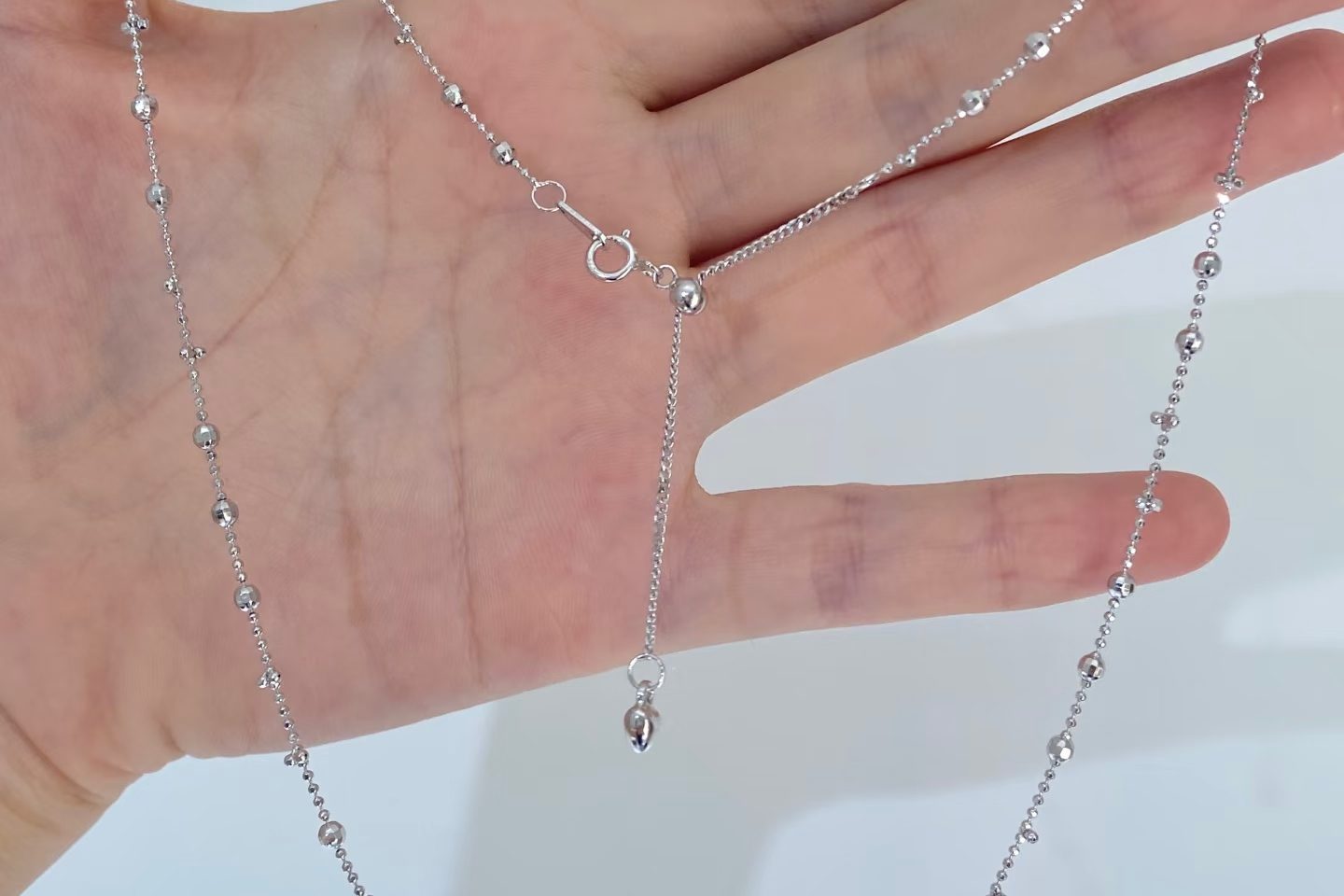
Choosing a white metal is the most consequential decision most buyers make without realising they are making it. The stone gets the attention; the metal determines how the ring looks in five years, what it costs to maintain, and whether it can be repaired when something goes wrong.
Three metals dominate the category — platinum, white gold and palladium — and they are sold with a great deal of vague language about "quality" and "purity". What actually separates them is density, wear mechanism, hardness, and maintenance cost. Those four things are measurable, and once you know them the choice is straightforward.
The three are not variations on a theme. They are different materials with different chemistry, and the names obscure that.
Platinum 950 is 95 percent platinum, alloyed with 5 percent of another metal — usually ruthenium, iridium or cobalt — to give it working properties. Pure platinum is too soft to use; the alloy is what makes it a jewelry metal. It is a single material throughout, with no plating and no surface layer to wear through.
Palladium 950 is 95 percent palladium, alloyed with 5 percent ruthenium or another metal. Palladium is a sister metal to platinum in the same group of the periodic table, and it behaves similarly in wear, at roughly half the density and historically at a lower price.
White gold is not a metal in this sense at all. It is yellow gold alloyed with white metals — traditionally nickel, now more often palladium, silver or manganese — to mute the natural yellow, and then plated with rhodium to produce the bright white surface. The rhodium plating is what you see. The alloy underneath is warmer, and it is what appears when the plating wears.
That distinction matters more than any other point in this article. Platinum and palladium are white all the way through. White gold is white because of a coating.
|
Platinum 950 |
Palladium 950 |
14K White Gold |
18K White Gold |
| Composition |
95% Pt + 5% alloy |
95% Pd + 5% alloy |
58.5% Au + white metals |
75% Au + white metals |
| Density |
21.45 g/cm³ |
12.02 g/cm³ |
~12.6–13.1 g/cm³ |
~14.5–15.0 g/cm³ |
| Vickers hardness |
110–135 HV |
110–120 HV |
140–180 HV |
125 HV |
| Plating required |
No |
No |
Yes, rhodium |
Yes, rhodium |
| Colour |
Naturally white, slightly grey |
Naturally white, slightly grey |
Warm white under plating |
Warm white under plating |
| Hypoallergenic |
Yes |
Yes |
Depends on alloy |
Depends on alloy |
| Resize difficulty |
High |
Moderate to high |
Low |
Low |
A note on prices
All prices are street prices observed in 2026 across US and EU retailers.
Density and weight in the hand
Platinum is the densest of the three by a wide margin. At 21.45 g/cm³ it is nearly twice the density of 14K white gold at around 12.8, and about 80 percent denser than palladium at 12.02.
The practical consequences are immediate and mostly in platinum's favour.
A platinum ring feels heavier. A comparable men's wedding band in platinum will weigh 14 to 18 grams against 8 to 10 grams in 14K white gold. People describe this as a sense of substance, and it is not imaginary — the ring is genuinely denser, and the weight sits differently on the finger.
A platinum ring can be made thinner for the same strength. Because the metal is denser and tougher, a 2mm platinum band has more structural integrity than a 2mm white gold band. This is why platinum rings are often slimmer than their white gold equivalents, and why the weight difference in a finished ring is smaller than the density figures suggest.
Palladium sits between the two, and closer to white gold. At 12.02 g/cm³ it is only slightly denser than 14K white gold, so a palladium ring does not have the heft people associate with platinum. Buyers who expect platinum's weight and receive palladium's are frequently disappointed, and this is worth knowing before you buy.
The weight is also a cost driver, because these metals are sold by weight. A platinum ring contains more grams than a white gold ring of the same size, and if the metal price per gram were equal, the platinum ring would cost proportionally more for that reason alone. The metal prices are not equal, which complicates the comparison — more on that below.
The wear mechanism — the real difference
This is the part that decides how a ring looks after a decade, and it is the point most salespeople skip.
Platinum displaces rather than loses metal. When platinum is scratched or abraded, the metal is pushed aside rather than removed. A scratch raises a fine ridge of displaced metal on either side of the groove, and the total mass of the ring is essentially unchanged. Over years of wear, a platinum ring develops a patina — a soft, matte, slightly hazy finish — rather than thinning. The edges round, the surface dulls, and the ring gets a worn-in look that many people find attractive and others want polished out.
The practical consequence is that a platinum ring does not wear out in the way a white gold ring does. Prongs do not thin as fast. A platinum setting holds a stone for longer between retipping. After twenty years a platinum ring is still a platinum ring at nearly its original weight.
White gold loses metal. When white gold is abraded, the metal is removed. The ring thins, the prongs lose material, and the rhodium plating wears through to reveal the warmer alloy beneath. Two things are happening at once: structural loss and cosmetic loss, and they proceed at different rates.
The plating wears fastest at contact points — the inside of the band where it meets the finger, the outer edges of the shank, the tips and edges of prongs. This is why a two-year-old white gold ring typically shows a duller, yellower band on the inside and bright white elsewhere.
Palladium behaves like platinum in mechanism and closer to white gold in rate. It displaces rather than loses metal, and it develops a patina, but it is softer in practice and scratches more visibly. It does not require plating, which is its main advantage over white gold.
Vickers hardness numbers
Hardness is where white gold wins on paper, and it is worth being precise about why that advantage is smaller than it looks.
| Metal |
Vickers hardness |
| Rhodium plating |
~800 HV |
| 14K white gold (nickel alloy) |
140–180 HV |
| 18K white gold |
~125 HV |
| Platinum 950 |
110–135 HV |
| Palladium 950 |
110–120 HV |
| Fine silver, for reference |
~25 HV |
Two observations.
White gold is harder than platinum. This is true and frequently quoted. A 14K white gold ring resists scratching better than a platinum one, and it keeps a polish longer. If resistance to visible scratching is your priority, white gold is the better metal.
But the surface you touch is rhodium, at around 800 HV. The hardness of the underlying white gold alloy is largely irrelevant to how the ring looks, because you are not touching the alloy — you are touching the plating, which is harder than both platinum and palladium. What fails on a white gold ring is not the alloy but the bond between the plating and the alloy, and the plating's thickness, which is measured in fractions of a micron.
So the honest summary: white gold scratches less, until the plating wears through, at which point it looks worse than a platinum ring of the same age. Platinum scratches more visibly but never loses its colour, and its scratches can be polished out without meaningfully reducing the ring.
Replating and maintenance costs
This is where the ten-year cost of ownership diverges, and it is the argument that most often decides the purchase once it is laid out plainly.
White gold
Rhodium plating wears through on a daily-wear ring in 12 to 24 months. Replating costs $30 to $80 and takes a few days at the bench.
| Period |
Replatings |
Cost |
| 5 years |
2–4 |
$60–$320 |
| 10 years |
5–8 |
$150–$640 |
| 20 years |
10–16 |
$300–$1,280 |
Occasionally-worn pieces stretch this considerably. Earrings, pendants and dress rings may go five years or more between platings, because they do not contact a finger or a hard surface continuously.
Platinum
Platinum does not need plating, but it does need attention if you want it bright.
| Service |
Frequency |
Cost |
| Polish to restore brightness |
Every 1–3 years, optional |
$40–$100 |
| Prong tightening |
Every 1–2 years |
Often free with service |
| Repolish after damage |
As needed |
$60–$150 |
The honest position is that platinum maintenance is optional and white gold maintenance is not. A platinum ring with a patina is a legitimate aesthetic choice; a white gold ring with worn plating looks like a cheaper ring, because that is what it has become. If you like the matte patina, platinum costs you nothing to maintain beyond an occasional prong check.
The comparison over ten years
|
Platinum 950 |
Palladium 950 |
14K White Gold |
| Purchase premium over white gold |
+$300–$900 |
+$100–$400 |
— |
| Ten-year maintenance |
$0–$300 (optional) |
$100–$350 |
$150–$640 (mandatory) |
| Resize cost |
$150–$400 |
$120–$300 |
$40–$100 |
| Polish and refinish |
Included above |
Included above |
Included above |
The gap narrows considerably once maintenance is counted. A $600 platinum premium over ten years is offset by roughly $200 to $500 of avoided replating, plus the difference in how the two rings look at the end of the period.
Metal prices move, and 2026 is an unusual moment because gold has been trading well above platinum and palladium for several years.
Approximate 2026 metal prices per gram: gold $72–$78, platinum $32–$38, palladium $35–$42, rhodium $140–$200.
That ordering surprises people. Gold has been the most expensive of the three ring metals per gram, which means the metal cost of a white gold ring is not obviously lower than a platinum one.
Work the arithmetic on a comparable ring.
|
14K White Gold |
Platinum 950 |
Palladium 950 |
| Typical ring weight |
5.0 g |
7.5 g |
5.5 g |
| Fine metal content |
2.93 g Au |
7.13 g Pt |
5.23 g Pd |
| Metal price per gram |
~$75 |
~$35 |
~$38 |
| Metal value |
~$220 |
~$250 |
~$199 |
The metal values are within 25 percent of each other. So why does the platinum ring typically cost $300 to $900 more at retail?
Three reasons. Fabrication is harder. Platinum's melting point is around 1,768°C against gold's 1,064°C, so it requires different equipment, more time and a more skilled bench. Wastage is higher — platinum is difficult to recover from the bench and some is lost in every job. And the premium is partly positioning. Platinum is marketed as the premium metal, and the price reflects what the market will bear as much as it reflects cost.
The practical consequence: at 2026 metal prices, the price gap between platinum and white gold is smaller than the marketing suggests, and a large part of it is labour and margin rather than metal. If a retailer is quoting a $1,500 premium for platinum over 14K white gold on the same ring, ask what the gram weights are. The answer is often illuminating.
Allergies and skin reactions
Metal sensitivity is common, and it is the one category where palladium is unambiguously the best answer.
Nickel is the usual culprit. It is the most common contact allergen in the developed world, and it has historically been a component of white gold alloys, particularly the harder ones. The EU Nickel Directive restricts nickel release from items in prolonged skin contact, and nickel-releasing white gold is difficult to sell legally in Europe. In the United States, restrictions are weaker and nickel white gold remains common.
Platinum is effectively inert. Reactions to platinum are rare enough to be clinically negligible. If you have known metal sensitivity, platinum is safe.
Palladium is the safest option for nickel sensitivity. It is hypoallergenic, and palladium 950 contains no nickel. Palladium white gold — white gold alloyed with palladium rather than nickel — is also safe, and is the standard white gold sold in the EU. If you want white gold and have a nickel allergy, ask specifically whether the alloy is nickel-based or palladium-based, and get it in writing.
Rhodium plating is not a solution to nickel allergy. The plating does prevent contact between the alloy and the skin, but it wears through at exactly the points of contact, and the exposure begins before the plating is visibly gone.
The question to ask
"Is this white gold alloyed with nickel or palladium?" A retailer who cannot answer is a retailer who does not know what they are selling. Palladium white gold costs more than nickel white gold and is worth it for anyone with sensitivity.
Resizing and repair
Resizing is the hidden cost of platinum, and it is worth understanding before you buy.
White gold resizes easily. Gold alloys melt at manageable temperatures, most benches have the equipment, and the work is routine. A standard resize costs $40 to $100 and takes a few days. Sizing beads, half-size adjustments and even multi-size changes are straightforward.
Palladium resizes with difficulty. It is harder to work than gold and requires more specialised technique, and fewer benches will take the job. Expect $120 to $300, and expect to wait longer or to be told the bench does not do palladium at all.
Platinum is the hardest of the three. Its melting point is far above gold's, it requires dedicated equipment and a skilled platinum bench, and it is unforgiving of mistakes. A resize that costs $60 in white gold typically costs $150 to $400 in platinum. Many jewellers send platinum work out to a specialist, adding time.
There is a further consideration that applies to all three: some designs cannot be resized at all. A ring with a continuous pattern, a full channel of stones, or an engraved shank cannot be cut and rejoined without destroying the design. This is true in platinum and in white gold alike, and it is worth asking about before you buy if there is any chance the size will change.
Practically: if you are not confident about the size, or if you expect the ring to be resized more than once, platinum's resize cost is a real argument for white gold.
Ask yourself what you want the ring to look like in ten years, because the three metals age differently.
| Age |
Platinum 950 |
Palladium 950 |
14K White Gold |
| 1 year |
Slight matte haze; bright if polished |
Light scratching; still white |
Plating intact; bright |
| 3 years |
Visible patina; soft sheen |
Noticeable scratches; slightly duller |
Plating worn at contact points; warmer tone inside |
| 5 years |
Pronounced patina or repolished |
Moderate wear; still white |
Replated once or twice; thin at edges |
| 10 years |
Patina or bright; mass essentially unchanged |
Worn but structurally sound |
Replated 5–8 times; edges rounded; thinner |
Two honest points. First, platinum's patina is divisive. Some buyers love the soft, antique look and never polish. Others find it dull and polish annually. Both are fine, but if you expect a platinum ring to stay mirror-bright without maintenance, you will be disappointed. Second, white gold's decline is cosmetic before it is structural. A five-year-old white gold ring that looks tired is usually a $60 replating away from looking new again. It is not a ruined ring; it is a ring that needs servicing.
The right answer depends on how the piece will be worn, and the differences are large enough that a single recommendation would be wrong.
For an engagement ring worn daily
Platinum is the best answer for most people. It holds a setting more securely, it never loses its colour, it does not require replating, and its wear mechanism means the prongs stay sound for longer. The costs are the higher purchase price and the much higher resize cost.
14K white gold is the right answer if the budget is tight, if the size is uncertain, or if you want the hardest surface and do not mind replating every year or two. It is a perfectly good choice, and the money saved is better spent on the stone or the cut.
Palladium is a reasonable middle path for someone who wants a naturally white, hypoallergenic metal without platinum's price. Check that your jeweller can service it before you buy.
For a wedding band
Platinum for a band that will be worn daily for decades, particularly a plain band. The weight is pleasant, the maintenance is nil, and the wear resistance matters over a long horizon. The resize cost is the main drawback, which argues for getting the size right the first time.
14K white gold for a band that will be worn alongside an engagement ring, or where matching an existing piece matters. White gold bands replate less often than rings with prongs, because a plain band has no thin edges to wear.
Palladium for a hypoallergenic band on a budget. It is the lightest of the three, which some buyers prefer and others do not.
For a piece worn occasionally
18K white gold or 14K white gold. On a necklace, earrings or a dress ring, the wear that drives replating is minimal. A pendant does not rub against a finger or a hard surface continuously. Plating on an occasionally-worn piece can last five years or more, and the cost advantage over platinum is significant.
Platinum is usually unnecessary here. You are paying for durability you will not use. The exception is a piece with an expensive centre stone, where the security of a platinum setting is worth the premium.
On the 18K versus 14K white gold question
Many buyers assume 18K white gold is whiter because it is "better" gold. It is not.
Gold is yellow. The whiteness of white gold comes from the alloying metals that mute it, and at 18K there is 75 percent gold and only 25 percent room for those metals. At 14K there is 41.5 percent of alloying metal to work with. The result is that 18K white gold's base alloy is often slightly warmer and greyer than 14K's.
In practice this makes very little difference, because both are rhodium-plated. The surface you see is rhodium in both cases, and rhodium is the same colour regardless of what is under it. What 18K buys you in white gold is softness — Vickers 125 against 14K's 140 to 180 — and a higher metal cost, and it buys you nothing in appearance.
If you want the whitest possible white gold ring, the answer is not a higher karat. It is fresh rhodium plating, and it is the same plating at 14K and at 18K.
Frequently asked questions
Is platinum better than white gold for an engagement ring?
For daily wear, platinum is the more durable choice. It is denser, holds a setting more securely, and when it scratches the metal is displaced rather than lost, so the ring does not thin over time. White gold is harder on paper but loses its rhodium plating and requires replating every 12 to 24 months. Platinum costs more up front and much more to resize.
How often does white gold need to be replated?
Every 12 to 24 months with daily wear, and sooner on a ring, because the plating wears at the points of contact — the inside of the band, the edges of prongs and the sides of the shank. Replating costs $30 to $80 and takes a few days. A ring worn only occasionally may go five years or more between platings.
Why is 18K white gold not whiter than 14K?
Because gold is yellow. At 18K there is more gold and less room for the white metals that mute its colour, so the base alloy is often slightly warmer and greyer than 14K. In practice it makes little difference, because both are rhodium-plated and the plating — not the alloy — is the surface you actually see.
Is palladium a good choice for a wedding band?
Yes, with caveats. Palladium is lighter than platinum and cheaper, it is hypoallergenic, and it does not require plating. The drawbacks are that it is harder to work, so fewer benches will resize or repair it, and it scratches more readily than platinum. Availability has narrowed as the metal's price has been volatile.
Can platinum rings be resized?
Yes, but it is more difficult and more expensive than white gold. Platinum has a very high melting point and requires specialised equipment and a skilled bench, so a resize that costs $40 to $100 in white gold often costs $150 to $400 in platinum. Some designs — particularly those with a continuous pattern or channel-set stones — cannot be resized at all in either metal.
The bottom line
For a ring worn every day, buy platinum. It costs $300 to $900 more up front, it never loses its colour, it does not need replating, and it holds a setting more securely for longer. Count the ten-year maintenance and the gap is smaller than the sticker price suggests. The one thing to get right is the size, because resizing platinum costs $150 to $400.
Buy 14K white gold if the budget matters, if the size is uncertain, or if you want the hardest surface and accept replating every 12 to 24 months at $30 to $80 a time. It is not a compromise metal; it is a different trade-off, and for an occasionally-worn piece it is the better one.
Buy palladium if you have a nickel allergy and want a naturally white metal without platinum's price — but confirm first that your jeweller can resize and service it, because that is where palladium ownership goes wrong.
And ignore the karat question in white gold. 18K white gold is not whiter than 14K. The whiteness is rhodium, and it is the same rhodium either way.